Last updated: July 3, 2026
This article reflects information available at the time of writing. Check Google Maps for the latest hours and availability.
Introduction
Fukushima doesn’t get the udon headlines that Namba or Umeda do. That’s partly why it’s worth your time. This compact neighbourhood just one stop west of Osaka Station on the JR Loop Line has quietly built a small but genuinely interesting udon scene — one that ranges from a whole-grain, sub-¥1,000 counter shop that opens at 7am, to a Michelin Bib Gourmand spot run by the team behind one of Osaka’s most decorated kaiseki restaurants.
What ties these three shops together isn’t style — they’re quite different — but seriousness. Each one makes its own noodles, takes its dashi seriously, and has a clear point of view. You won’t find chain-style udon here. What you will find is a neighbourhood that eats well without making a fuss about it.
Fukushima is also easy to navigate on foot. The three shops in this guide sit within a roughly 10-minute walk of each other, clustered around JR Fukushima and JR Shin-Fukushima stations. Come hungry, come on a weekday if you can, and come before noon — two of these places run out of noodles or close early enough that a late lunch is a gamble.
1. Udon Sanku (うどん讃く)
- 📍 2-8-3 Fukushima, Fukushima-ku, Osaka
- 🕐 Mon, Wed–Sun: 7:00–10:00 / 11:00–18:30; closed Tuesday (as of May 2026)
- 💰 Budget per person: ¥350–¥999 (food only)
- 🚃 JR Shin-Fukushima Station (3 min walk) / JR Fukushima Station (5 min walk)
- 🗺 Open in Google Maps
- 📋 Tabelog
What to order: Bukkake udon (¥450) or kake udon (¥350) + katsudon set (¥800 combo)
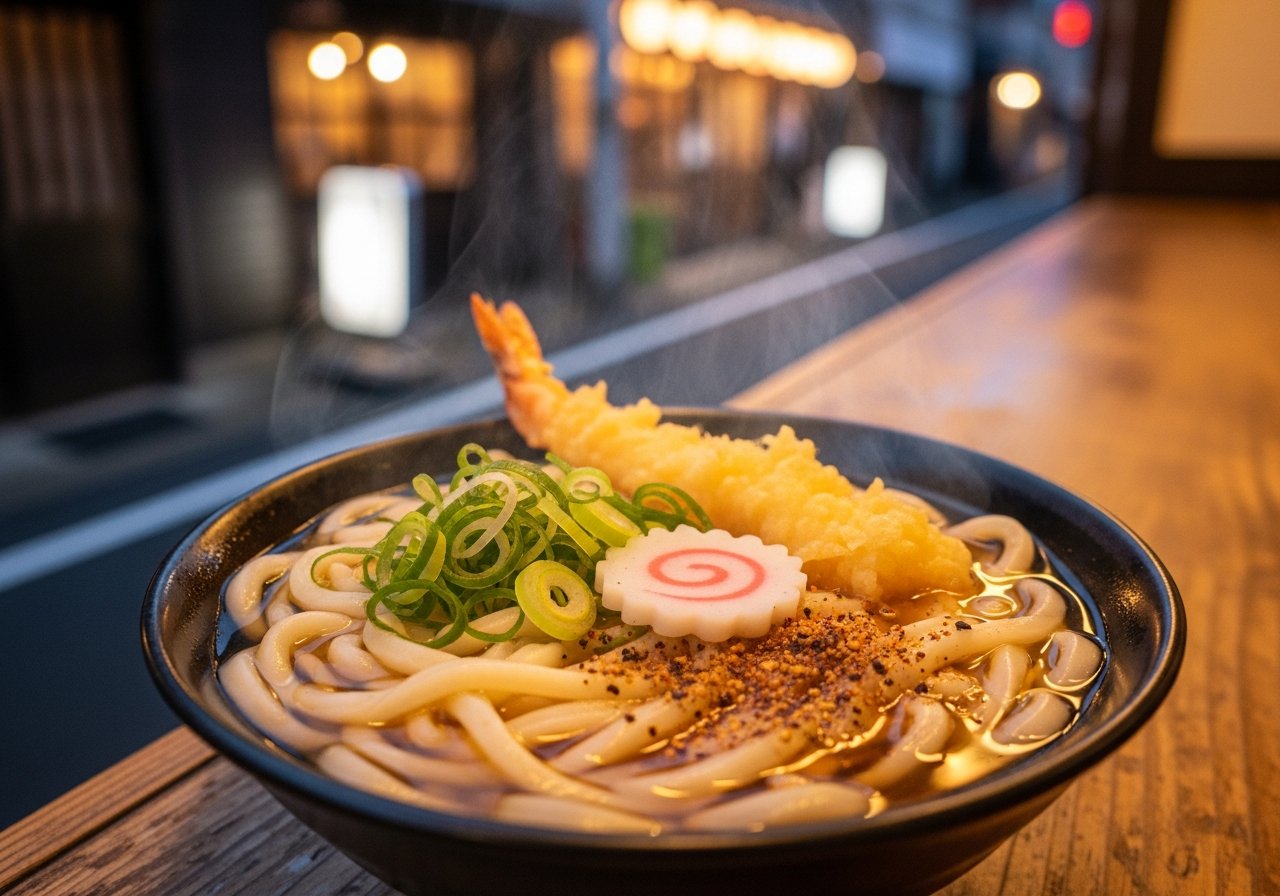
This is a udon shop in Fukushima, Osaka, and its defining feature is noodles made with whole wheat flour. The dashi runs in a fragrant Sanuki style — heavy on iriko — and it pairs well with the thick, chewy noodles. It’s a ticket-machine, counter-service setup: buy your ticket, hand it over, collect your bowl, then swing by the condiment station for scallions, ginger, tempura flakes, and chilli. The menu covers the Sanuki udon basics, plus curry udon, tempura, and dashimaki tamago, alongside rice bowl sets that make it feel more like a proper neighbourhood diner than a noodle-only shop. The noodles are handmade with whole grains and the quantity is generous for the price. The lunch queue moves fast — this is not a place to linger, but it’s absolutely a place to come back to.
2. Oudon Yomogi (おうどん蓬)
- 📍 2-10-6 Sazusu, Fukushima-ku, Osaka (Camino Sazusu 1F)
- 🕐 Lunch: Sat, Sun, public holidays 12:00–15:00 (last order 14:30); Dinner: Mon, Tue, Fri–Sun 17:30–22:00 (last order 21:30); closed Wednesday and Thursday (as of May 2026)
- 💰 Budget per person: ¥900–¥1,500 (lunch, food only) / ¥3,000–¥5,000 (dinner with dishes and drinks)
- 🚃 JR Fukushima Station (8 min walk)
- 🗺 Open in Google Maps
- 📋 Tabelog
What to order: Kake udon (¥900) + kitsune-age topping (¥220) + takikomi gohan (¥350)
Oudon Yomogi is a sister shop of Ryori Miyamoto, which has held two Michelin stars for eleven consecutive years. The shop opened in April 2023 and earned its own Michelin Bib Gourmand listing in the 2024 Kyoto and Osaka guide. The udon here is built around the dashi — the broth is crafted with the same care as a first-draw stock for kaiseki, drawing out every bit of flavour from the ingredients. Toppings arrive on a separate plate so the soup stays clean and unmuddied. The broth uses Hokkaido true kombu steeped cold, then layered with katsuobushi, sababushi, and urumebushi. Lunch is weekends only, so plan accordingly. Dinner is a different animal — small plates, sake, and udon as the closer rather than the main event. Either way, book ahead.
3. Fukushima Udon-dokoro Shimizu (福島うどん処しみず)
- 📍 Near JR Shin-Fukushima Station, Fukushima-ku, Osaka (confirm exact address via Google Maps)
- 🕐 Mon–Fri 11:30–14:00; closed Saturday, Sunday, and public holidays (as of May 2026)
- 💰 Budget per person: ¥900 (kasu udon teishoku, food only)
- 🚃 JR Shin-Fukushima Station (1 min walk)
- 🗺 Open in Google Maps
- 📋 Tabelog
What to order: Kasu udon teishoku (¥900) — includes udon, rice (or kayaku gohan), and karaage after 1pm
This is a weekday-only lunch counter that doubles as an izakaya at night under a different name — which tells you something about the neighbourhood’s practical, no-ceremony approach to eating. The specialty is kasu udon: a clear, well-drawn dashi broth topped with abura-kasu, the rendered beef offal that’s become a distinctly Osaka ingredient. The thin noodles have real backbone despite their slender cut, and the broth is clean and dashi-forward. The teishoku set at ¥900 is one of the better-value lunches in the area — rice, udon, and free karaage if you arrive after 1pm. Strictly weekday, strictly lunchtime. Don’t show up on a Saturday.
How to Order
Two of the three shops here use ticket machines (Sanku) or table ordering (Yomogi and Shimizu), so the process differs by venue. At Sanku, buy your ticket before you sit — the machine has many options, so decide what you want before you queue. The condiment station is self-service: scallions, ginger, tempura flakes, and chilli are free to add. At Yomogi, you’ll order at the table; the lunch menu is short and focused, so decisions are easy. At Shimizu, ordering is done verbally at the counter.
A few practical notes. Sanku is cash or IC card; Yomogi does not accept credit cards — cash or PayPay only. None of the three have English menus, but Sanku’s ticket machine has photos alongside the Japanese text, which helps. At Yomogi, the menu is short enough that pointing works fine. Shimizu’s lunch set is essentially one item, so there’s little to navigate.
Udon in Fukushima is a lunch-first culture. Sanku opens at 7am for breakfast and runs until 6:30pm, but the other two close by mid-afternoon. If you’re planning a udon crawl, start at Sanku for a morning bowl, then hit Yomogi on a weekend lunch. Shimizu is your weekday-only option for a quick, no-fuss set meal.
FAQ
Q: Is udon in Fukushima expensive?
A: Not at all. Sanku is the most affordable — a plain kake udon is ¥350, and even a full set with a rice bowl stays under ¥1,000. Shimizu’s teishoku lands at ¥900. Yomogi is the outlier: lunch runs ¥900–¥1,500 per person, and dinner with dishes and drinks can reach ¥3,000–¥5,000. For what you get at Yomogi — Michelin-level dashi in a 18-seat room — that’s still reasonable.
Q: Do these shops have English menus?
A: None of the three have English menus. Sanku’s ticket machine has photos, which makes it manageable. Yomogi’s lunch menu is short enough to navigate by pointing. Shimizu is essentially a single-set lunch, so there’s almost nothing to decide. Staff at all three are used to non-Japanese speakers figuring it out.
Q: When is the best time to visit?
A: For Sanku, the 7–9am breakfast window is the quietest — the lunch rush from 11:30am onwards brings queues, though they move quickly. For Yomogi, arrive at opening (noon on weekends) to avoid a wait; it only seats 18 and fills up. Shimizu is a short lunch window on weekdays only — aim for 11:30am to guarantee a seat before the office crowd arrives.
Information is accurate as of May 2026. We recommend checking Google Maps for the latest hours and prices before visiting.