Last updated: July 3, 2026
This article reflects information available at the time of writing. Check Google Maps for the latest hours and availability.
Introduction
Kitashinchi is Osaka’s most storied entertainment district — a tight grid of narrow streets north of Dojima where expense accounts have been settled over extraordinary food for decades. It’s the kind of neighbourhood where the restaurants don’t need signs out front, because the people who eat here already know where they’re going. For visitors, cracking that code takes a little work. This guide does it for you.
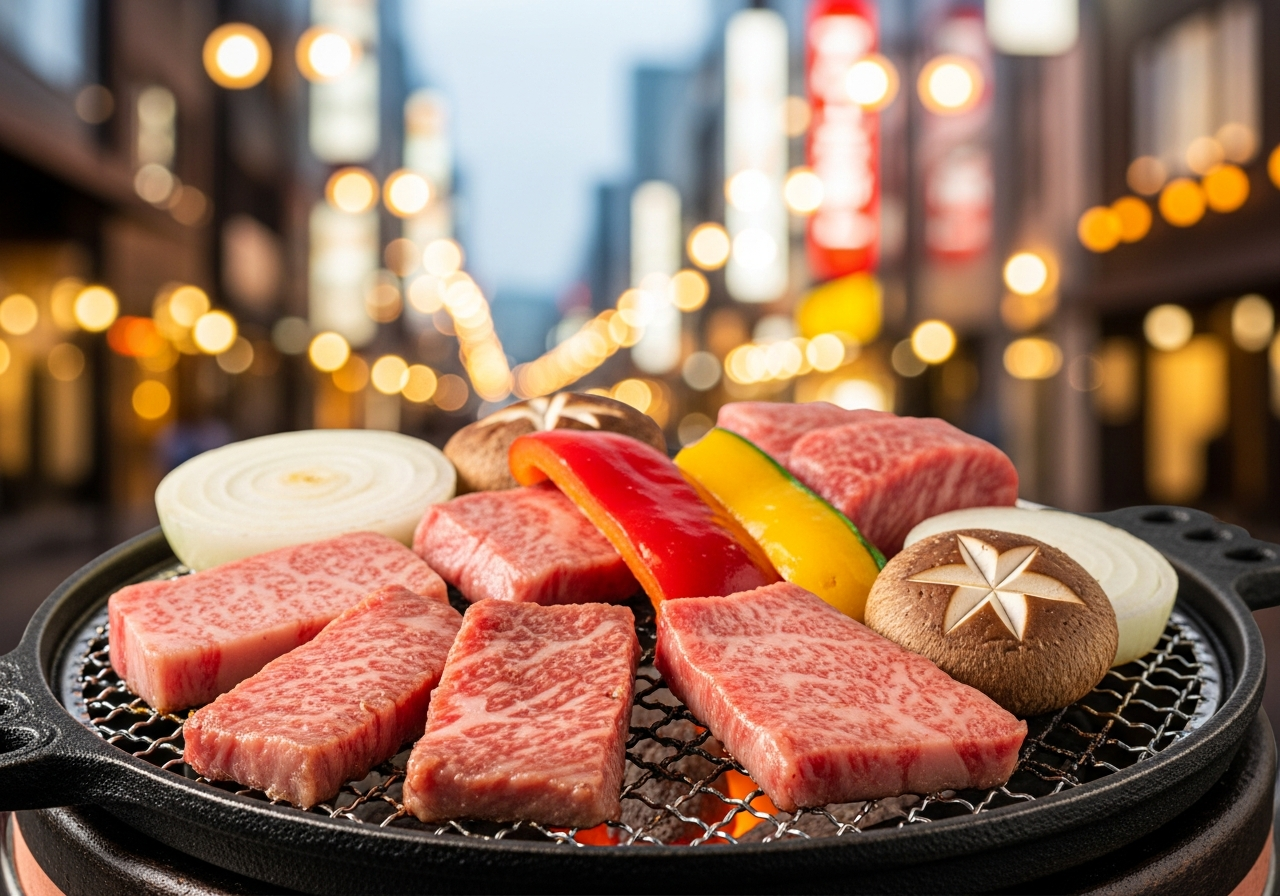
Yakiniku in Kitashinchi operates at a different register from the grill-it-yourself chains you’ll find near Namba or Shinsaibashi. Here, the beef is almost always A5 black wagyu — sourced from specific prefectures, aged with intention, and often grilled tableside by a member of staff who knows exactly when to pull each cut. Private rooms are the norm. Courses start around ¥11,000 and climb steeply from there. You are not paying for the square footage; you are paying for beef that has been selected, handled, and cooked with genuine care.
If you want to understand why Osaka has a reputation as Japan’s food capital, a yakiniku dinner in Kitashinchi is one of the clearest arguments. For a broader look at the best food in Osaka, our full food guide covers everything from street-level kushikatsu to omakase counters. But for a special-occasion dinner — a birthday, an anniversary, a business meal that needs to impress — the five restaurants below are where to start. To explore more of Kitashinchi beyond the grill, our area guide covers the bars, jazz clubs, and late-night spots that make this neighbourhood worth lingering in.
All five restaurants below are reservation-only or strongly reservation-recommended. Book at least a week ahead for weekends; two weeks for special occasions.
1. Kitashinchi Yakiniku Kiraku (北新地焼肉きらく)
- 📍 Palmary Inn 2F, 1-2-7 Dojima, Kita-ku, Osaka 530-0003
- 🕐 Mon–Sat 17:00–24:00 (LO 23:00), Sun 17:00–23:00 (LO 22:00) (as of May 2026)
- 💰 ¥11,000–¥22,500 per person (food only, course-based)
- 🚃 Kitashinchi Station (5 min walk) / Oebashi Station (4 min walk)
- 🗺 Open in Google Maps
- 📋 Tabelog
- 🌐 Official site
What to order: Super Negi Tan Shio (included in all courses from ¥11,000)
Kiraku is the most-booked yakiniku room in Kitashinchi for good reason: every seat is a private booth, the beef rotates daily by brand and region, and the signature Super Negi Tan Shio — tongue buried under a mosaic of lemon slices and spring onion — is one of those dishes that actually lives up to its reputation. A Tabelog Yakiniku WEST Top 100 selection since 2023, with courses running from the accessible ¥11,000 Kiraku Course up to the ¥22,500 Shiawase Course for serious occasions.
2. Oniku Takumi (おにく Takumi)
- 📍 1-8-16 Sonezaki Shinchi, Kita-ku, Osaka 530-0002
- 🕐 Daily from 17:00 (last seating by arrangement) (as of May 2026)
- 💰 ¥15,000–¥25,000 per person (food only, omakase course)
- 🚃 Kitashinchi Station (3 min walk)
- 🗺 Open in Google Maps
- 📋 Tabelog
What to order: Omakase course featuring Omi beef (from ¥15,000)
Oniku Takumi is a full-attendance yakiniku counter — meaning staff grill every cut for you, at the exact moment it should be eaten. The beef is Omi wagyu, sourced from long-raised female cattle with the kind of clean, sweet fat that doesn’t overwhelm. Two courses are available, both structured to alternate grilled cuts with small composed dishes. It’s the closest thing in Kitashinchi to an omakase experience in the traditional sense: you sit down, you trust the kitchen, and you eat exceptionally well.
3. Takumi no Yakiniku Sekiguchi (匠の焼肉 せきぐち 北新地店)
- 📍 1-6-19 Sonezaki Shinchi, Kita-ku, Osaka 530-0002
- 🕐 Mon–Fri 17:00–23:30 (LO 22:30), Sat 17:00–23:00 (LO 22:00); closed Sundays (as of May 2026)
- 💰 ¥10,000–¥15,000 per person (food only)
- 🚃 Kitashinchi Station (4 min walk)
- 🗺 Open in Google Maps
- 📋 Tabelog
What to order: A5 female wagyu red meat course with kama-meshi rice (from ¥10,000)
Sekiguchi’s pitch is lean red meat over heavily marbled cuts — a deliberate choice that makes the beef taste like beef rather than fat. The kitchen sources A5 female black wagyu and serves it over charcoal, finishing the meal with kama-meshi rice cooked in a clay pot. It’s a more restrained style of Kitashinchi yakiniku, and the lower entry price makes it the most accessible option on this list without any meaningful compromise on quality. Nine fully private rooms, so it works equally well for a date or a business dinner.
4. Wagyu Matsushita Uedori (和牛まつした 上通り店)
- 📍 1-9-20 Sonezaki Shinchi, Kita-ku, Osaka 530-0002
- 🕐 Mon–Sun 17:00–23:30 (LO 23:00) (as of May 2026)
- 💰 ¥12,000–¥20,000 per person (food only, course-based)
- 🚃 Kitashinchi Station (3 min walk)
- 🗺 Open in Google Maps
- 📋 Tabelog
What to order: A5 wagyu yakiniku course with truffle nigiri and beef chazuke finish (from ¥12,000)
Matsushita specialises in A5 female black wagyu sourced primarily from western Japan’s top-producing regions, wet-aged in-house for maximum depth of flavour. The course structure is genuinely thoughtful: rare cuts like black wagyu tongue and outside skirt sit alongside grilled shabu-shabu, seared sushi, and a truffle nigiri with egg sauce before the meal closes with a beef chazuke. Horigotatsu sunken-floor seating is available, which makes it one of the more comfortable long-dinner options in the neighbourhood. Banquet seating for up to 30 guests.
5. Kitashinchi Wagyu Yakiniku Gokan (北新地 和牛焼肉 五感)
- 📍 J Pride Building 2F, 1-11-24 Sonezaki Shinchi, Kita-ku, Osaka 530-0002
- 🕐 Mon–Fri 17:30–02:00, Sat 17:30–00:00; closed Sundays and public holidays (as of May 2026)
- 💰 ¥12,000–¥20,000 per person (food only)
- 🚃 Kitashinchi Station (5 min walk)
- 🗺 Open in Google Maps
- 📋 Tabelog
- 🌐 Official site
What to order: Wagyu omakase course with wine pairing (from ¥12,000)
Gokan stays open until 2am on weekdays, which makes it the go-to option when the rest of Kitashinchi has called last orders. That late-night flexibility doesn’t come at the cost of quality: the kitchen runs a proper wagyu course with over 50 wines available, many from France, and the sommelier pairing is worth the upgrade. The beef is sourced from Japan’s top-producing regions and changes with availability. If you’re arriving after 10pm and want something that still feels like a considered dinner rather than a late-night scramble, this is the room.
How to Order
Every restaurant on this list operates primarily on a course-menu basis. Walk-ins are rarely possible — book online via Tabelog, the restaurant’s official site, or through a reservation platform like Ikyu or Tableall. Most restaurants require a credit card to hold the booking, and cancellation fees (often 100% on the day) are standard in Kitashinchi.
When you arrive, you’ll typically be asked to choose your course for the evening. Courses are priced per person and usually include a set sequence of cuts, small dishes, soup, and a rice or noodle finish. Drinks are almost always ordered separately — budget an additional ¥3,000–¥5,000 per person for drinks, or ask about all-you-can-drink add-ons, which several restaurants offer.
At full-attendance restaurants like Oniku Takumi, staff will grill every cut for you. At the others, you grill yourself over charcoal or gas — staff will usually demonstrate the correct technique for each cut when it arrives. Don’t rush the tongue: it needs a full minute per side over medium heat. Don’t overcook the fillet. When in doubt, ask.
Dietary restrictions are difficult to accommodate at course-only restaurants. If you don’t eat certain cuts or have allergies, contact the restaurant at least 48 hours before your reservation. Most can adjust, but they need notice.
FAQ
Q: Is yakiniku in Kitashinchi expensive?
A: Yes, by most standards. Entry-level courses start around ¥10,000–¥11,000 per person for food only. Add drinks and you’re typically looking at ¥14,000–¥18,000 per person for a full evening. The top-tier courses at places like Kiraku and Oniku Takumi run ¥20,000–¥25,000 per person. That said, the beef quality — A5 wagyu, often from named regional breeds — justifies the price in a way that comparable cuts at a steakhouse rarely do.
Q: Do these restaurants have English menus?
A: Some do, some don’t. Kitashinchi Yakiniku Kiraku and Wagyu Matsushita have English-language course descriptions available on their Tabelog and booking pages. For the others, booking through an English-language platform like Tableall or byFood often includes English menu support. Google Translate’s camera function handles printed menus reasonably well in a pinch. Staff at most Kitashinchi restaurants are accustomed to international guests and will do their best to explain cuts.
Q: When is the best time to visit?
A: Weekday evenings are significantly easier to book than weekends, and the atmosphere is arguably better — Kitashinchi is a business-entertainment district, so Tuesday through Thursday evenings have a particular energy. Avoid Golden Week (late April to early May) and the year-end season (mid-December) unless you book two to three weeks in advance. For late-night dining, Gokan’s 2am closing on weekdays is the most flexible option in the neighbourhood.
Information is accurate as of May 2026. We recommend checking Google Maps for the latest hours and prices before visiting.