Last updated: July 3, 2026
This article reflects information available at the time of writing. Check Google Maps for the latest hours and availability.
Introduction
Tenmabashi doesn’t get the same izakaya press as Namba or Tenma, and that’s exactly why it’s worth your evening. Sitting on the east bank of the Okawa river, this is a working district — government offices, law firms, the old Osaka City Hall — and the izakaya scene reflects it. These are places where people actually eat after work, not spots that exist to be photographed. Prices are honest, portions are generous, and the crowd is local enough that you’ll feel like you’ve stumbled into something real.
The area clusters around two stations: Tenmabashi on the Keihan and Osaka Metro Tanimachi lines, and Tanimachi 4-chome one stop south. Between them you’ll find everything from riverside seafood halls with views of the Okawa to tight yakitori counters where the binchotan smoke hits you before you even open the door. If you want to understand the best food in Osaka beyond the tourist circuit, this neighbourhood is a strong argument.
This guide covers six izakaya that are genuinely worth the trip — different in style, price, and vibe, but all currently operating and all recommended without reservation. Whether you’re after a quick solo highball and skewers or a long group dinner with Kyushu shochu and private rooms, Tenmabashi has a seat for you. To explore more of Tenmabashi beyond the izakaya scene, check our full neighbourhood guide.
1. Tazuko (田鶴子)
- 📍 1-7-31 Otemae, Chuo-ku, Osaka (OMMビル B2F)
- 🕐 Mon–Fri 11:30–14:00, 17:00–23:00; Sat–Sun 17:00–23:00 (as of May 2026)
- 💰 ¥2,000–¥3,000 per person (food only) / ¥2,500–¥3,500 (with drinks)
- 🚃 Tenmabashi Station (directly connected)
- 🗺 Open in Google Maps
- 📋 Tabelog
What to order: Odatebuta charshu (¥680), lemon sour (¥380)
Directly connected to Tenmabashi Station via the OMM Building basement, Tazuko is the kind of place you duck into on a Tuesday when you don’t want to think too hard. Up to 90 seats, cheap drinks, and a menu that covers all the izakaya bases — the signature Yamagata-raised pork charshu is thick, fatty, and worth ordering twice.
2. Nakai Tenmabashi (なかい 天満橋)
- 📍 1-4-3 Tanimachi, Chuo-ku, Osaka
- 🕐 Mon–Fri 17:00–23:30; Sat 16:00–23:30; Sun 16:00–22:30 (as of May 2026)
- 💰 ¥3,500–¥5,000 per person (food only) / ¥4,000–¥5,500 (with drinks)
- 🚃 Tanimachi 4-chome Station (3 min walk) / Tenmabashi Station (5 min walk)
- 🗺 Open in Google Maps
- 📋 Tabelog
- 🌐 Official site
What to order: Yakitori omakase 5-skewer set (¥890), karaage (¥800)
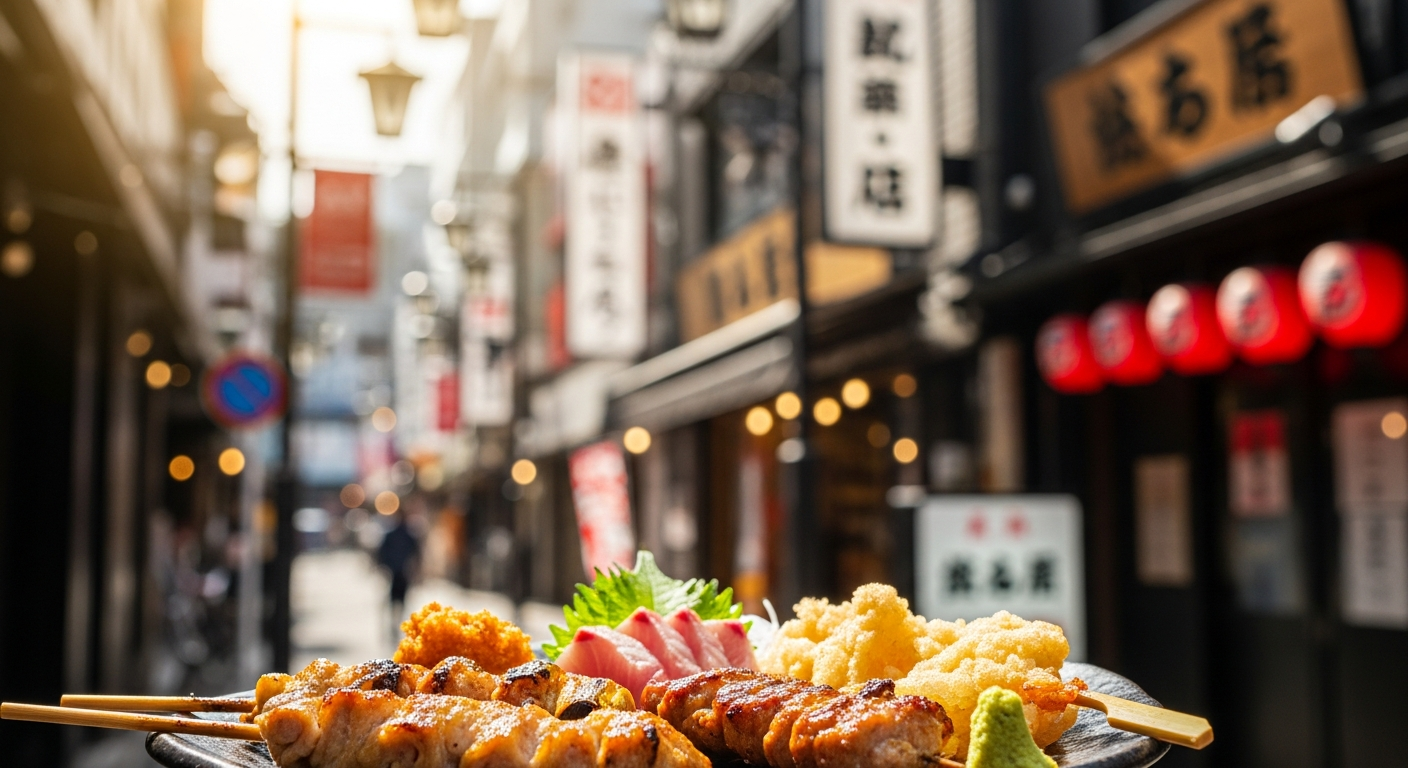
Nakai is the rare izakaya that pairs Belgian draft beer with charcoal-grilled yakitori and somehow makes it feel completely natural. The chicken is sourced carefully — Tamba black chicken and Shinshu chicken both appear on the menu — and the skewers are grilled over binchotan at the counter. Book ahead; it fills up fast on weekdays.
3. Daiki Suisan Maguro Stadium (天下の台所 大起水産 八軒家浜 まぐろスタジアム)
- 📍 1-1 Hackenya-hama, Chuo-ku, Osaka (Keihan City Mall riverside floor)
- 🕐 Mon–Fri 17:00–23:00; Sat–Sun 12:00–23:00 (as of May 2026)
- 💰 ¥2,500–¥4,000 per person (food only) / ¥3,500–¥5,000 (with drinks)
- 🚃 Tenmabashi Station (3 min walk)
- 🗺 Open in Google Maps
- 📋 Tabelog
What to order: Maguro milefeuille nigiri (¥500/piece), hon-maguro sashimi platter (¥800–¥1,200)
Run by Daiki Suisan — one of Osaka’s most respected fishmongers — this 100-seat riverside hall does a nightly tuna breakdown show, and the fish that lands on your plate minutes later is noticeably fresher than anything you’d get at a standard izakaya. Floor-to-ceiling windows face the Okawa; the neon-lit cruise boats drifting past are a bonus. The signature maguro milefeuille — three layers of lean, marinated, and otoro tuna stacked on a single piece of rice — is ¥500 and worth every yen.
4. Sumibi Yakitori Ikoka Tenmabashi (炭火焼鳥 いこか 天満橋)
- 📍 1-4-8 Tanimachi, Chuo-ku, Osaka
- 🕐 Mon–Sat 17:00–23:30 (last order 23:00); closed Sundays (as of May 2026)
- 💰 ¥3,000–¥4,500 per person (food only) / ¥4,000–¥6,000 (with drinks)
- 🚃 Tanimachi 4-chome Station (2 min walk)
- 🗺 Open in Google Maps
- 📋 Tabelog
What to order: Seasonal omakase skewer set (¥1,200–¥1,800), Kyoto black chicken thigh (¥280/skewer)
This is the spot for a proper binchotan yakitori experience without the Kitashinchi price tag. Kishu white charcoal, Kyoto black chicken and Shinshu chicken, a counter where you can watch the grill — Ikoka takes the craft seriously. The seasonal omakase skewer set changes every few months and is the easiest way to let the kitchen show off. Sake and shochu list is solid; the staff will help you pair if you ask.
5. Kitashinchi Toriya Tanimachi 4-chome (北新地鳥屋 谷町四丁目店)
- 📍 2-1-28 Tanimachi, Chuo-ku, Osaka
- 🕐 Mon–Fri 17:00–23:30; Sat 16:00–23:30; closed Sundays (as of May 2026)
- 💰 ¥2,500–¥4,000 per person (food only) / ¥3,500–¥5,000 (with drinks)
- 🚃 Tanimachi 4-chome Station (2 min walk)
- 🗺 Open in Google Maps
- 📋 Tabelog
What to order: Chicken hot pot (mizutaki, ¥1,500/person), crispy chicken skin skewer (¥180)
Over 25 years in the same spot, and the regulars still show up on a Tuesday like it’s a religious obligation. The chicken hot pot — a rich, cloudy broth built from whole birds — is the reason to come, especially between October and March. Horigotatsu seating makes long evenings comfortable, and the happy hour drink deals in the early evening are genuinely good. Unpretentious, reliable, and the kind of place you’ll want to return to.
6. Satsuma Gokamon Tenmabashi (薩摩ごかもん 天満橋総本店)
- 📍 1-1 Tenmabashi Kyomachi, Chuo-ku, Osaka (Keihan City Mall 8F)
- 🕐 Mon–Fri 11:30–15:00, 17:00–23:00; Sat–Sun 11:30–23:00 (as of May 2026)
- 💰 ¥3,000–¥4,500 per person (food only) / ¥4,000–¥5,500 (with drinks)
- 🚃 Tenmabashi Station (directly connected)
- 🗺 Open in Google Maps
- 📋 Tabelog
What to order: Katsuo tataki (¥1,100), chicken nanban (¥980), Kagoshima shochu (¥550/glass)
Eight floors up in the Keihan City Mall, directly above the station, Satsuma Gokamon brings Kyushu to Tenmabashi with all-private-room seating and a menu anchored in Kagoshima and Fukuoka cooking. The katsuo tataki is seared to order and arrives with a heap of ginger and ponzu. Unlimited karaage, rice, mentaiko, and takana as a side deal on the lunch set is the kind of thing that makes you want to move to this neighbourhood. Dinner is more composed — good for groups who want a proper sit-down without the Namba prices. The MICHI Osaka travel guide covers more Kyushu-style spots across the city if this style of cooking is your thing.
How to Order
Most Tenmabashi izakaya follow the same rhythm: sit down, order drinks first, then work through small plates as the evening goes. A table charge (otoshi) of ¥300–¥500 per person is standard — it usually arrives as a small snack and is non-negotiable. Don’t skip it; it’s part of the deal.
At counter-style yakitori spots like Ikoka and Nakai, ordering by the skewer is normal. Two or three skewers per round, reorder as you go. At larger places like Tazuko and Maguro Stadium, the menu is laminated and often has photos — point if you need to. Staff at most of these spots will have basic English or enough patience to work through a language gap.
Reservations are strongly recommended Thursday through Saturday at Nakai, Ikoka, and Kitashinchi Toriya — all three fill up by 19:00 on busy nights. Tazuko and Maguro Stadium take walk-ins more reliably. If you’re a group of four or more, call ahead or book via Tabelog or Hot Pepper regardless of the day.
Drink-wise: draft beer (nama biru), highball (whisky and soda), and lemon sour (shochu with lemon) are the standard trio. At Satsuma Gokamon, the Kagoshima shochu list is the reason to go off-script. At Nakai, the Belgian taps are genuinely worth exploring.
FAQ
Q: Is izakaya dining in Tenmabashi expensive?
A: Not particularly. Budget ¥2,500–¥3,500 per person for a solid evening at Tazuko or Kitashinchi Toriya, including two or three drinks. Nakai and Satsuma Gokamon run ¥4,000–¥5,500 with drinks if you order freely. Maguro Stadium sits in the middle — ¥3,500–¥5,000 depending on how much tuna you eat.
Q: Do these izakaya have English menus?
A: Maguro Stadium and Satsuma Gokamon (both in shopping complexes) are the most likely to have English or photo menus. Tazuko has a laminated menu with photos that makes pointing easy. The smaller yakitori spots — Ikoka and Kitashinchi Toriya — are Japanese-only, but the staff are used to non-Japanese guests and will work with you. Google Translate’s camera function handles most menus without drama.
Q: When is the best time to visit?
A: Weeknights between 18:00 and 20:00 are peak hours — the after-work crowd hits hard. If you want a seat without a wait at the popular spots, aim for 17:30–18:00 or after 20:30. Weekends are quieter than you’d expect, since this is primarily a working-district crowd. Maguro Stadium is the exception — it draws weekend visitors for the riverside views and is busier on Saturdays.
Information is accurate as of May 2026. We recommend checking Google Maps for the latest hours and prices before visiting.