Last updated: July 3, 2026
This article reflects information available at the time of writing. Check Google Maps for the latest hours and availability.
Introduction
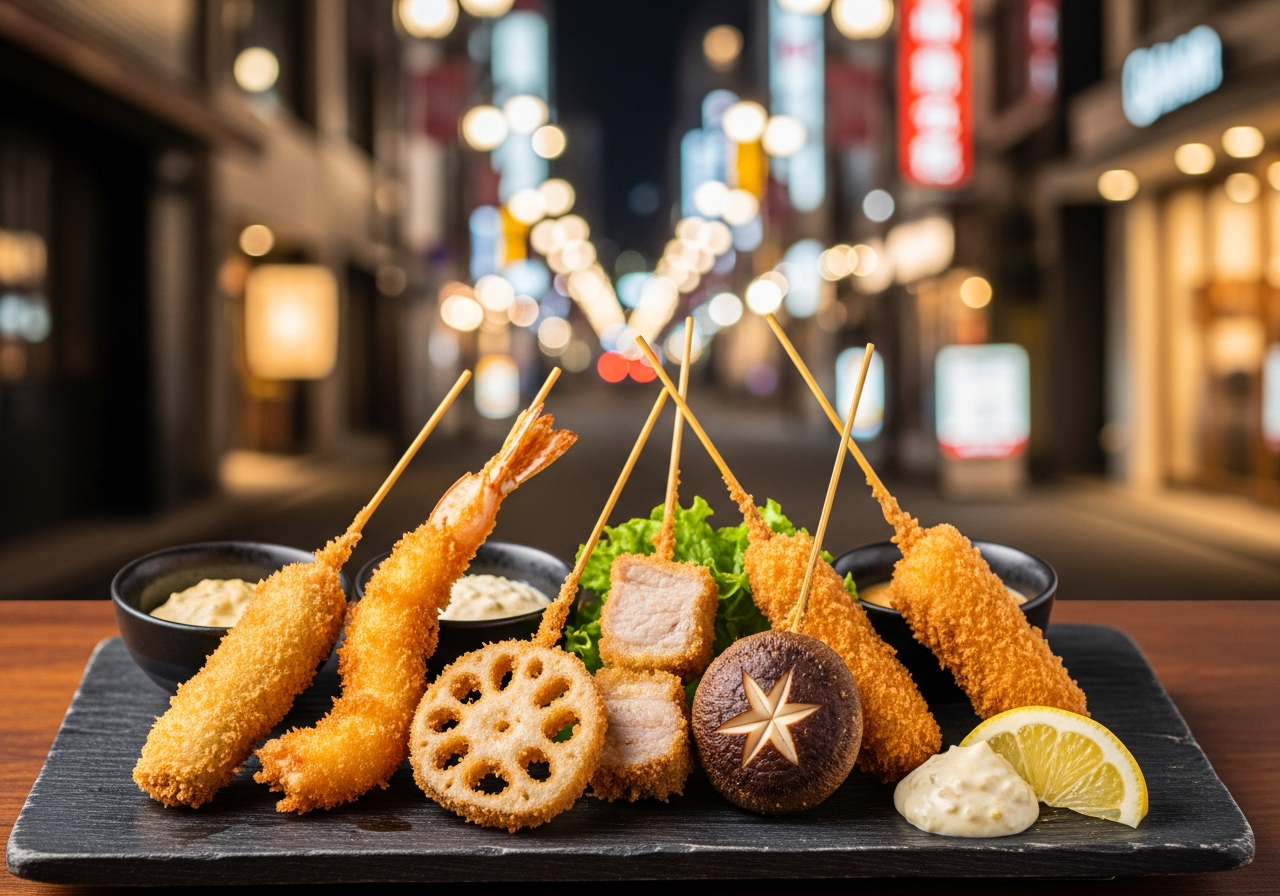
Kitashinchi is where Osaka’s appetite gets serious. The district sits a short walk north of Umeda — compact, low-lit, and lined with the kind of restaurants that don’t need signs out front because their regulars already know where to go. It’s the city’s most concentrated stretch of high-end dining, and kushiage fits right in. What started as working-class street food in Shinsekai has, in Kitashinchi, been quietly reimagined into something closer to omakase counter dining — seasonal ingredients, precise frying, and sauces that have nothing to do with the communal dipping pot you’d find at a casual kushikatsu chain.
The four spots in this guide cover the full range of what Kitashinchi kushiage actually looks like in 2026: a Michelin-featured counter that has been doing this since 2004, a Bib Gourmand pick with globally-inspired skewers, a French-Japanese fusion counter that skips sauce entirely, and a 50-year-old institution that still draws a crowd at lunch. If you want to understand the best food in Osaka, this neighbourhood — and this category — is a good place to start.
Reservations are essential at all four. Walk-ins are possible at lunch at one or two of them, but don’t count on it. Budget ¥8,000–¥20,000 per person for dinner depending on how many skewers you eat and how much you drink. And if you want to explore more of Kitashinchi beyond kushiage, the neighbourhood rewards wandering — there are serious cocktail bars and sushi counters within a few minutes of every spot on this list.
1. Kushikatsu Bon (串カツ 凡)
- 📍 B1F Dojima Merry Center Building, 1-3-16 Dojima, Kita-ku, Osaka
- 🕐 18:00–24:30 (last entry 22:30) (as of May 2026)
- 💰 ¥14,000–¥20,000 per person (food only)
- 🚃 Kitashinchi Station (3 min walk)
- 🗺 Open in Google Maps
- 📋 Tabelog
What to order: Omakase course — 16–20 skewers (¥14,000–¥20,000 depending on course length); Gyukatsu Sandwich add-on (¥450)
Established in 2004, Kushikatsu Bon has spent two decades elevating Osaka’s casual kushikatsu into a first-class cuisine — and earned a Michelin star for eight consecutive years in the process. The kushiage is deep-fried in a custom copper pot using a unique blend of oils based on cottonseed oil, and the results are noticeably lighter than anything you’d find at a casual chain. With the motto “kushiage without being bound by common sense,” they work with high-end ingredients like foie gras, caviar, and sea urchin. Chef Otani and his team present a “STOP-style” omakase — you keep eating until you say stop. The guideline is around 20 skewers for approximately ¥14,000. The restaurant also has a branch in Paris, which tells you something about how seriously they take the concept. Book well in advance — this is one of the harder reservations in the neighbourhood.
2. Kushiage 010 (串揚げ 零一零)
- 📍 4F Tanaka Building, 1-1-41 Sonezaki Shinchi, Kita-ku, Osaka
- 🕐 17:00–22:00; closed Sundays and public holidays (as of May 2026)
- 💰 ¥5,000–¥10,000 per person (food only)
- 🚃 Kitashinchi Station (4 min walk)
- 🗺 Open in Google Maps
- 📋 Tabelog
What to order: Short course (approx. ¥5,000) or standard course (approx. ¥8,000–¥10,000)
Kushiage 010 sits four minutes on foot from JR Kitashinchi Station and has earned Michelin Bib Gourmand recognition — the category that flags quality cooking at honest prices. Their kushiage is fried in an original oil based on rice bran, and the courses freely arrange seasonal ingredients from appetisers through to dessert. The defining characteristic is creative skewers inspired by cuisines from around the world — prosciutto with figs, or black pork fillet stuffed with foie gras. There’s a strong selection of natural wines and shochu alongside original cocktails. The interior uses wood-grain counter and chairs, keeping the atmosphere calm and unhurried. It’s the most accessible entry point on this list — both in price and in atmosphere — and a smart choice if you want Michelin-level execution without the full ceremony of Bon.
3. Kushiage TAKENAKA (串揚げ タケナカ)
- 📍 B01, Taniyasu Building, 1-3-4 Dojima, Kita-ku, Osaka
- 🕐 Lunch 11:30–14:00 (LO 13:30); Dinner 18:00–24:00 (LO 22:00); closed Sundays and public holidays (as of May 2026)
- 💰 ¥1,000–¥2,000 (lunch) / ¥8,000–¥10,000 (dinner, food only)
- 🚃 Kitashinchi Station (5 min walk)
- 🗺 Open in Google Maps
- 📋 Tabelog
What to order: Omakase full course (¥8,000–¥9,999 at dinner); Lunch course from ¥1,300
TAKENAKA is the most conceptually distinct spot on this list. Opened in November 2015, it’s built around a collaboration between a Japanese cuisine chef and a French chef — the result is a fusion of the two traditions expressed through kushiage. The defining feature is a sauce-free approach: the skewers are seasoned individually, letting the ingredients speak without a shared dipping pot in sight. The counter seats just ten people, all facing the open kitchen, and the pacing is deliberate — this is a full-evening commitment, not a quick bite. Tabelog score sits at 3.61 with over 260 reviews, which for a ten-seat counter in Kitashinchi is a strong signal. Lunch is a genuine bargain at around ¥1,300 for a set, and one of the few ways to experience the kitchen without booking weeks ahead.
4. Kushidokoro Mogami Kitashinchi (串処 最上 北新地店)
- 📍 1-chome, Sonezaki Shinchi, Kita-ku, Osaka (1 min walk from Kitashinchi Station — confirm exact address via Google Maps)
- 🕐 Lunch Mon–Sun 11:30–15:00 (LO 14:30); Dinner 17:00–23:00 (LO 22:00) (as of May 2026)
- 💰 ¥5,000–¥6,000 (lunch course) / ¥7,500–¥13,500 (dinner, food only)
- 🚃 Kitashinchi Station (1 min walk)
- 🗺 Open in Google Maps
- 📋 Tabelog
- 🌐 Official site
What to order: STOP-style omakase course — 15 skewers (¥7,500) or 36 skewers (¥13,500)
Founded in 1971, Mogami is the oldest kushiage counter in this guide — and it shows in the best possible way. The kitchen uses a specially blended safflower oil and a custom frying pot, and the skewers pull from land, sea, river, and field. The STOP-style format means skewers keep coming — a mix of classic and seasonal — until you call it. The menu runs to 36 varieties, and the restaurant offers five-language menus for international guests, including a flag service where they bring out your country’s flag at the table. That last detail is either charming or slightly theatrical depending on your tolerance, but the cooking itself is the real draw. Lunch here — a 10-skewer set with rice, miso soup, and salad for ¥5,500 — is one of the better-value meals in the neighbourhood. The MICHI Osaka travel guide recommends booking at least a few days ahead for dinner.
How to Order
All four restaurants on this list operate on a course or omakase basis — there’s no à la carte menu to scroll through. At most counters, you’ll be asked at the start whether you have any allergies or strong dislikes, and the kitchen adjusts accordingly. At STOP-style restaurants (Bon, Mogami), skewers arrive one or two at a time and you simply say “stop” — in English, that works fine — when you’ve had enough. At 010 and TAKENAKA, you choose a course length upfront.
Sauce etiquette varies by restaurant. At Bon and Mogami, a shared dipping sauce is provided — use it once per skewer, never twice. At TAKENAKA, there’s no shared sauce at all; each skewer is seasoned individually before it reaches you. Follow the chef’s lead on how to eat each piece — they’ll often indicate whether to eat it plain, with salt, or with a specific condiment.
Reservations are non-negotiable for dinner at all four spots. Use Tablecheck, Ikyu, or the restaurant’s own booking page. For lunch, Mogami and TAKENAKA occasionally have walk-in availability on weekdays, but calling ahead is still the safer move. Bring cash as a backup — most accept cards, but not all accept foreign cards without issue.
FAQ
Q: Is kushiage in Kitashinchi expensive?
A: Relative to casual kushikatsu in Shinsekai or Namba, yes. Dinner at these four spots runs ¥5,000–¥20,000 per person depending on the restaurant and how many skewers you eat. Lunch is significantly cheaper — ¥1,300–¥5,500 — and a legitimate way to experience the same kitchens at a fraction of the cost.
Q: Do these shops have English menus?
A: Mogami explicitly offers five-language menus. At Bon and 010, staff are accustomed to international guests and can explain courses in basic English. TAKENAKA is the most Japanese-language-dependent of the four, though the counter format means you can follow along visually. Reservations made through English-language platforms (Tablecheck, OMAKASE) often allow you to flag language needs in advance.
Q: When is the best time to visit?
A: Weekday evenings are quieter and easier to book. Friday and Saturday nights fill up weeks in advance at Bon and 010. Lunch on a weekday is the lowest-friction option — shorter waits, lower prices, and the same kitchen. Avoid national holidays unless you’ve booked well ahead; most of these restaurants close on public holidays entirely.
Information is accurate as of May 2026. We recommend checking Google Maps for the latest hours and prices before visiting.