Last updated: July 3, 2026
Information changes — always confirm with the venue/source before relying on it.
Introduction
For vegan travelers, Japan’s fine dining scene can feel like a locked door. If you are a strict vegan, you cannot simply show up to a kaiseki restaurant and ask the chef to alter the menu on the fly — to a kaiseki chef, removing the dashi or the soy sauce is akin to asking a French chef to cook without butter. Yet the picture in Osaka is more nuanced and more exciting than that warning suggests. More and more Osaka restaurants are offering vegan menus, and with Michelin Guide first-class restaurants at the forefront, kaiseki and shojin ryori establishments are making plant-based food more accessible by using traditional plant-based ingredients to create unique course menus.
This guide explains what kaiseki and shojin ryori actually are, where the hidden animal ingredients lurk, which Osaka venues have plant-based options available, how to book correctly, and what Japanese phrases to use when you arrive. Whether you are planning a once-in-a-trip splurge or simply want to understand the landscape before you explore more of Osaka, this is the practical primer you need.
Kaiseki vs. Shojin Ryori: Know the Difference Before You Book
The two terms are often confused, but they describe very different dining traditions — and the distinction matters enormously for vegan travelers.
Kaiseki (懐石 / 会席) is Japan’s traditional multi-course haute cuisine. Kaiseki ryori is Japan’s traditional multi-course dining experience, renowned for its artfully crafted dishes that highlight fresh, seasonal ingredients. The term “kaiseki” originates from the tea ceremony, where it initially referred to a simple meal served before tea gatherings, and over time it evolved into an elegant and sophisticated dining tradition celebrated in high-end ryotei and top-tier establishments. There are no set rules for how many courses a kaiseki meal must feature, since ingredients are determined by season availability and the chef’s personal preferences — you can find kaiseki meals containing anywhere from six to fifteen courses. The standard sequence moves through courses named by cooking method: wanmono (a dashi broth course, considered the mark of a chef’s ability), hassun (marking the seasonality of the meal), tsukuri (a sashimi course), yakimono (a grilled course), aemono (a chilled vegetable-forward dish), mushimono (steamed), agemono (fried), and shokuji — a rice course served at the end with miso soup and pickles.
Shojin ryori (精進料理) is a fundamentally different tradition. Shojin ryori is a plant-based traditional Buddhist cuisine, often vegan as well, with a large focus on seasonal vegetables alongside the absence of meat and fish, and a guiding principle of zero waste when cooking. One major difference is that kaiseki is not strictly plant-based and often includes dishes that incorporate meat or fish, while shojin ryori is traditionally vegetarian and usually vegan. It was originally part of a monk’s training routine and was brought into Japan from India and China; during the Heian Period (798–1185), shojin ryori became more common in Japan.
In practice, the most exciting development for vegan diners is the growing overlap: kaiseki and shojin ryori restaurants are making vegan food more accessible by using traditional plant-based ingredients to create unique course menus. Some Osaka chefs now draw on shojin ryori techniques to build fully plant-based kaiseki-style courses — the best of both worlds.
🔗 Source: omakaseje.com
The Dashi Problem — and How Vegan Kaiseki Solves It
The single biggest obstacle for vegan diners in Japanese fine dining is dashi. Kaiseki leans on dashi — kelp and bonito stock — so delicate it’s almost a whisper, lifting ingredients rather than drowning them. The biggest culprit making the search difficult is dashi — soup stock used in tons of dishes such as ramen, takoyaki, and miso soup. Dashi is not vegan as it includes katsuoboshi (dried bonito fish flakes), but many restaurants will still claim a dish is vegan or vegetarian even if it uses dashi — not out of malice, but simply because the definition of “vegan” is a little different in Japan.
The concepts of vegetarian and vegan aren’t mainstream in Japan and are often misunderstood — fish flakes and broth made from fish flakes are frequently considered vegan by Japanese people, who insist that dashi is a seasoning and not meat. This is why specifying your needs in writing, in Japanese, is essential at any fine dining venue.
The good news is that skilled kaiseki chefs have a ready alternative. Instead of bonito-based dashi, chefs create deep, layered flavors using vegetable peels and cores, kombu seaweed, miso, and vegan-friendly soy sauce — and through fermentation and careful preparation, the dishes achieve richness and complexity entirely plant-based. Kombu (kelp) dashi is the traditional backbone of shojin ryori, and shojin ryori is typically vegetarian and vegan-friendly, done by using konbu kelp dashi to create all the dishes. When booking, always confirm explicitly that katsuobushi-based dashi will be replaced — not simply omitted.
One more hidden ingredient to watch for: there have been cases of dairy and egg-based ingredients turning up in meals, with monks explaining to disappointed vegan diners that, since animals aren’t killed for these ingredients, they consider them acceptable. This is the exception not the norm, but it is still necessary to be on the alert for animal products at all shojin ryori restaurants. Confirm eggs (tamago/卵), dairy (nyūseihin/乳製品), and honey (hachimitsu/はちみつ) are excluded, not just meat and fish.
🔗 Source: japanfoodtravels.com
Where to Find Plant-Based Fine Dining in Osaka
Osaka’s fine dining scene has several distinct tiers for vegan travelers, from Michelin-starred innovation to accessible tofu kaiseki chains. For a broader overview of the city’s plant-based scene beyond fine dining, see our Osaka vegan guide.
The Michelin pinnacle: HAJIME
Having achieved the prestigious rank of three Michelin stars faster than any restaurant in the world, HAJIME presents a dining experience defined by extraordinary precision and detail — at the heart of HAJIME is Chef Hajime Yoneda, whose mission is to “create the ultimate emotion in the world.” For vegan travelers, the key fact is that HAJIME offers a course composed mainly of vegetables, recommended for those who are vegetarian or vegan. The lengthy course menu, available in both a classic and vegetable course, stretches as long as four hours, while diners explore the connection between food and planet. HAJIME offers a vegan menu tailored to guests’ preferences, and also provides options for vegetarians, pescatarians, and accommodates dietary restrictions related to religious practices. The restaurant is located in Nishi-ku, Osaka, a short walk from Higobashi Station on the Osaka Metro Yotsubashi Line. Due to the intricacies of preparation and cooking methods, changes cannot be accommodated upon arrival — any adjustments must be communicated at least one day in advance.
Naniwa kaiseki with vegan options: Ajikitcho Bumbuan
Chef Nakatani serves classical dishes from Osaka — naniwa kaiseki and kamigata ryori, a style from the Kyoto and Osaka regions. While Ajikitcho Bumbuan doesn’t offer a dedicated vegan course menu, Chef Nakatani is happy to use his skills in preparing shojin ryori to tailor his omakase for vegan guests when possible. Vegan courses are by request only, accepted at the discretion of the restaurant. Awarded one Michelin star for 14 consecutive years, Ajikitcho has also recently celebrated its 50th anniversary. Make special note whether fish-based dashi is acceptable at the time of reservation, as some requests may be more difficult to handle.
Tofu-focused kaiseki: Umenohana
Umenohana is a traditional kaiseki multi-course restaurant chain with a big focus on tofu. The entire restaurant has a traditional setting with tatami mats covering the floor, and the experience is similar to that of a fine dining restaurant. A reservation is required to enjoy the vegan kaiseki (菜食懐石) at Umenohana, though same-day reservation is accepted. Umenohana has multiple locations in Osaka, making it one of the most accessible entry points into plant-based kaiseki dining.
Fermentation-forward shojin ryori: ODORU
Japanese Fermented Degustation Bar ODORU is a restaurant located a five-minute walk from Honmachi Station in Osaka City, offering dishes that utilize fermentation nurtured by Japan’s climate. The vegan-style cuisine, based on shojin ryori, is gentle on both the mind and body, and the flavors and charms of the ingredients are concentrated. It offers a pairing course that allows guests to enjoy three types of natural sake made from organic, pesticide-free rice.
Shojin ryori with a modern twist: Yuki Chaya Ajyari
Yuki Chaya Ajyari offers original shojin ryori with a modern twist. The shop has the relaxing atmosphere of a traditional Japanese house, and the owner studied various kinds of cuisine including shojin ryori herself. Ajyari is a kaiseki cuisine restaurant located near Hankyu Railway Ikeda Station, where vegan and vegetarian dishes based on Buddhist cuisine can be eaten. Note that you need to make a reservation beforehand if you are to order vegan or vegetarian menus.
🔗 Source: omakaseje.com, savorjapan.com
How to Read a Kaiseki Menu as a Vegan
Understanding the standard course structure helps you identify which courses are naturally plant-based and which require substitution. Here is a practical breakdown:
- Sakizuke (先付) — An appetizer intended to prepare the diner for the meal and introduce the chef’s style, similar to the amuse-bouche in French dining. Often tofu or seasonal vegetable-based; confirm no dashi glaze.
- Hassun (八寸) — A course that establishes the seasonal theme of the meal. Typically a tray of small bites; in a standard menu this may include seafood, so request a full vegetable substitution.
- Suimono / Wanmono (椀物) — The soup course. A soup made from dashi stock meant to cleanse the palate. This is the course most likely to contain katsuobushi dashi — the critical one to flag at booking.
- Mukozuke / Tsukuri (向付) — A plate of premium seasonal sashimi. In a vegan course, this is replaced entirely — often with marinated vegetables, yuba (tofu skin), or seasonal pickles.
- Takiawase (炊き合わせ) — A vegetable dish served alongside meat, fish, or tofu. The vegetable component is naturally plant-based; confirm the simmering broth uses kombu dashi.
- Yakimono (焼き物) — A course of flame-grilled seasonal fish in a standard menu. In a vegan kaiseki, this becomes grilled seasonal vegetables or tofu dengaku.
- Aemono (和え物) — A chilled, vegetable-forward dish featuring a thick sauce, usually sesame or tofu, sometimes used as a palate cleanser. One of the most naturally vegan-friendly courses.
- Shokuji (食事) — A rice course served at the end of a meal with miso soup and pickles. Confirm the miso soup uses kombu dashi, not katsuobushi.
Kaiseki courses are categorized by cooking method, with each dish representing one of the methods. Not all dishes may be present, however, as chefs will often include or omit dishes depending on the season and the chef’s individual style. This flexibility is actually an advantage for vegan diners — a skilled chef can substitute across the entire sequence without breaking the structural logic of the meal.
🔗 Source: guide.michelin.com
How to Book: Timing, Language, and Platforms
Booking a vegan kaiseki meal in Osaka requires more lead time and more communication than a standard restaurant reservation. If you are a strict vegan, you cannot simply show up to a kaiseki restaurant and ask the chef to alter the menu on the fly. Depending on the restaurant, they may not be able to procure ingredients if you contact them close to your reservation date, so it is preferable to make your reservation at least one week in advance. For Michelin-starred venues, two to four weeks is more realistic; HAJIME in particular requires dietary adjustments to be communicated at least one day before arrival, but ingredient preparation for some dishes begins up to three days ahead.
What to communicate at booking:
- State clearly that you are vegan (ビーガン, biigan) and avoid all animal products including meat, fish, dashi, eggs, dairy, and honey.
- Specify: 「だしも魚介類も使わないでください」 (Dashi mo gyokairui mo tsukawanaide kudasai) — “Please do not use dashi or seafood.”
- Confirm that kombu or vegetable-based dashi will be used as a substitute, not simply that the dish will be omitted.
- Carry a written allergy card in Japanese listing your specific restrictions — several free printable versions exist online specifically for Japan travel. Spoken phrases are helpful, but a card gives staff something concrete to bring to the kitchen.
Booking platforms for English speakers:
For high-end, chef-driven experiences like kaiseki, OMAKASE and TableCheck are the go-to platforms. They offer excellent English interfaces and direct booking for many popular and Michelin-recognized restaurants, with OMAKASE specializing in these premium spots and often showing real-time availability. For venues not listed on those platforms, if you are staying at a luxury hotel, their concierge service is generally complimentary for guests — one of the biggest perks of such establishments, though their services are typically reserved for higher-end restaurants.
Some restaurants offer full vegan course menus as standard fare, available without advance preparation, though guests should still mention any specific concerns in the booking notes, as understandings of veganism vary between cultures. Others are able to serve vegan courses with adequate advance notice. Always confirm which category applies before you arrive.
🔗 Source: japan.asoventure.jp
What to Expect: Atmosphere, Etiquette, and Cost
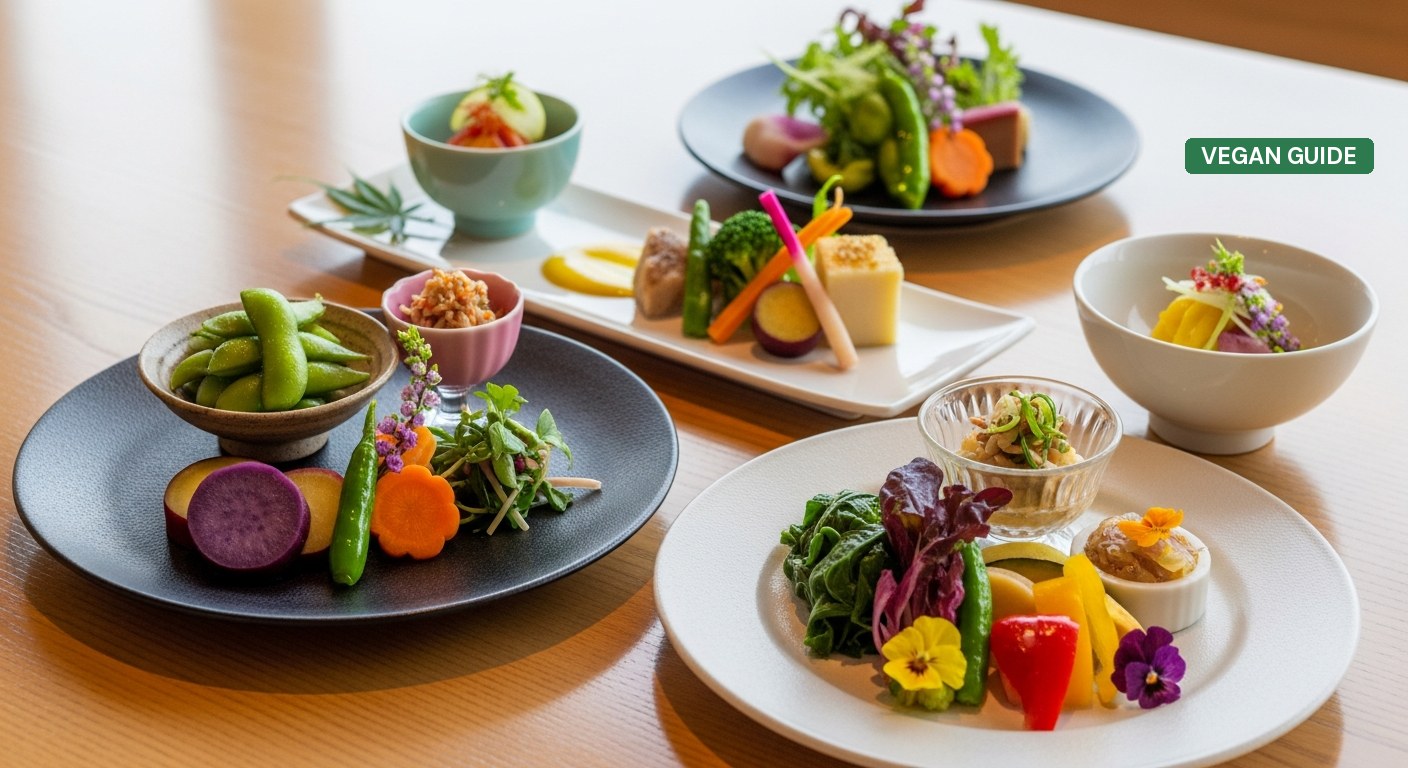
Kaiseki dining environments typically feature soft lighting, luxurious tableware, and an overall serene atmosphere to showcase the display of food. One of the highlights of kaiseki dining is the exquisite tableware used to present each dish — carefully chosen to reflect the season and the meal’s theme, the tableware enhances the dining experience, engaging not only the palate and sense of smell but also the eyes.
A kaiseki dinner typically lasts about two to three hours. Since each dish is served individually, the meal is meant to be enjoyed at a relaxed, leisurely pace, and the duration may vary depending on the number of courses and the restaurant’s service style. At HAJIME, the vegetable course runs approximately 3.5 hours.
On cost: the price of a kaiseki meal generally ranges from ¥10,000 to ¥30,000 per person. In high-end restaurants, the cost can often exceed this range. However, more affordable kaiseki options are available, starting at around ¥5,000, particularly at lunch. Umenohana’s vegan kaiseki lunch sets represent the accessible end of the spectrum, while HAJIME sits firmly at the top. For a broader look at what the best food in Osaka has to offer across all budgets, the city rewards exploration at every price point.
A few etiquette notes specific to vegan kaiseki dining:
- Before eating, say itadakimasu to the chef and restaurant staff to express your thanks for the meal — it translates as “I receive this food.”
- Do not ask to swap courses at the table. All vegan substitutions must be arranged before arrival.
- If an establishment politely declines your booking, accept it gracefully — they are protecting both their culinary standards and your experience.
- Shojin ryori menus change monthly to reflect seasonal produce — autumn mushrooms, winter root vegetables, and spring bamboo shoots are highlights. Book with the season in mind.
🔗 Source: omakaseje.com
Practical Tips for Vegan Travelers
- Book HAJIME’s vegetable course at least two weeks out. Due to the intricacies of preparation and cooking methods, changes cannot be accommodated upon arrival — communicate any adjustments at least one day in advance. Use the official HAJIME website or OMAKASE Japan Eatinerary for English-language bookings. The restaurant is a two-minute walk from Exit 7 of Higobashi Station on the Osaka Metro Yotsubashi Line.
- Use the phrase dashi mo dame desu (だしもだめです). Vegan eating is genuinely difficult in Japan not because of bad intentions but because dashi is a background ingredient in many dishes that appear safe — specify dashi mo dame desu (no dashi either) when communicating restrictions.
- Print a Japanese vegan card before you travel. The phrase Watashi wa biigan desu (私はビーガンです) means “I am vegan” and covers all animal products including dairy, eggs, and honey. Supplement this with a printed card listing every excluded ingredient — free templates are available from sites such as veggies-abroad.com.
- For Umenohana, same-day reservations are accepted. A reservation is required to enjoy the vegan kaiseki (菜食懐石) at Umenohana, but same-day reservation is accepted. This makes it the most spontaneous-friendly option for plant-based kaiseki in Osaka, with locations near Osaka Station and Morinomiya.
- Consider ODORU near Honmachi for a mid-range shojin ryori experience. Located a five-minute walk from Honmachi Station on the Osaka Metro Midosuji Line, ODORU’s vegan-style cuisine is based on shojin ryori and is gentle on both the mind and body. The fermentation-focused menu and natural sake pairing make it a strong alternative to full kaiseki formality.
- Use HappyCow and OMAKASE together. HappyCow has created a list featuring the best vegan restaurants in Osaka, as determined by the highest scores calculated from HappyCow community member reviews — useful for cross-referencing community feedback. Pair this with OMAKASE for Michelin-tier bookings where English support and real-time availability are essential.
Last updated: July 3, 2026 · Corrections: [email protected]