Last updated: July 3, 2026
This article reflects information available at the time of writing. Check Google Maps for the latest hours and availability.
Introduction
Tanimachi doesn’t get the kushikatsu headlines. That goes to Shinsekai, where the dish was born and where tourists queue outside Daruma before noon. But Tanimachi — the long, quiet corridor of temples, law offices, and old shotengai running south from Tenmabashi — has its own kushikatsu scene, and it’s a better fit for most evenings. The crowds are thinner, the prices are honest, and the clientele skews heavily local: office workers from the Osaka Prefectural Government buildings nearby, regulars who’ve been coming for years, the occasional couple who wandered off the tourist trail and got lucky.
If you’re already planning to visit Osaka Castle or the Osaka Museum of History — both a short walk from Tanimachi 4-chome station — this neighbourhood makes a natural dinner stop. You won’t find the theatrical atmosphere of Janjan Yokocho, but you will find skewers fried to order, cold beer, and no one trying to sell you a souvenir. For a broader look at the best food in Osaka, the city rewards exactly this kind of neighbourhood-first approach.
This guide covers three solid kushikatsu options within easy walking distance of Tanimachi 4-chome and Tenmabashi stations — one lively izakaya-style spot, one old-school hall, and one specialist shop that takes the craft seriously. All three are open as of May 2026. To explore more of Tanimachi, the neighbourhood has plenty more going on beyond the fryer.
1. Kushimon Sakaba Hibikiya Tanimachi 4-chome (串もん酒場 ひびき屋 谷町四丁目店)
- 📍 2F, 1-4-3 Tanimachi, Chuo-ku, Osaka-shi, Osaka 540-0012
- 🕐 Daily 17:00–01:00 (food last order 00:00, drinks last order 00:30) (as of May 2026)
- 💰 ¥2,000–3,000 per person (food only) / ¥3,500–5,000 (with drinks or course)
- 🚃 Tanimachi 4-chome Station, Exit 2 (1 min walk)
- 🗺 Open in Google Maps
- 📋 Tabelog
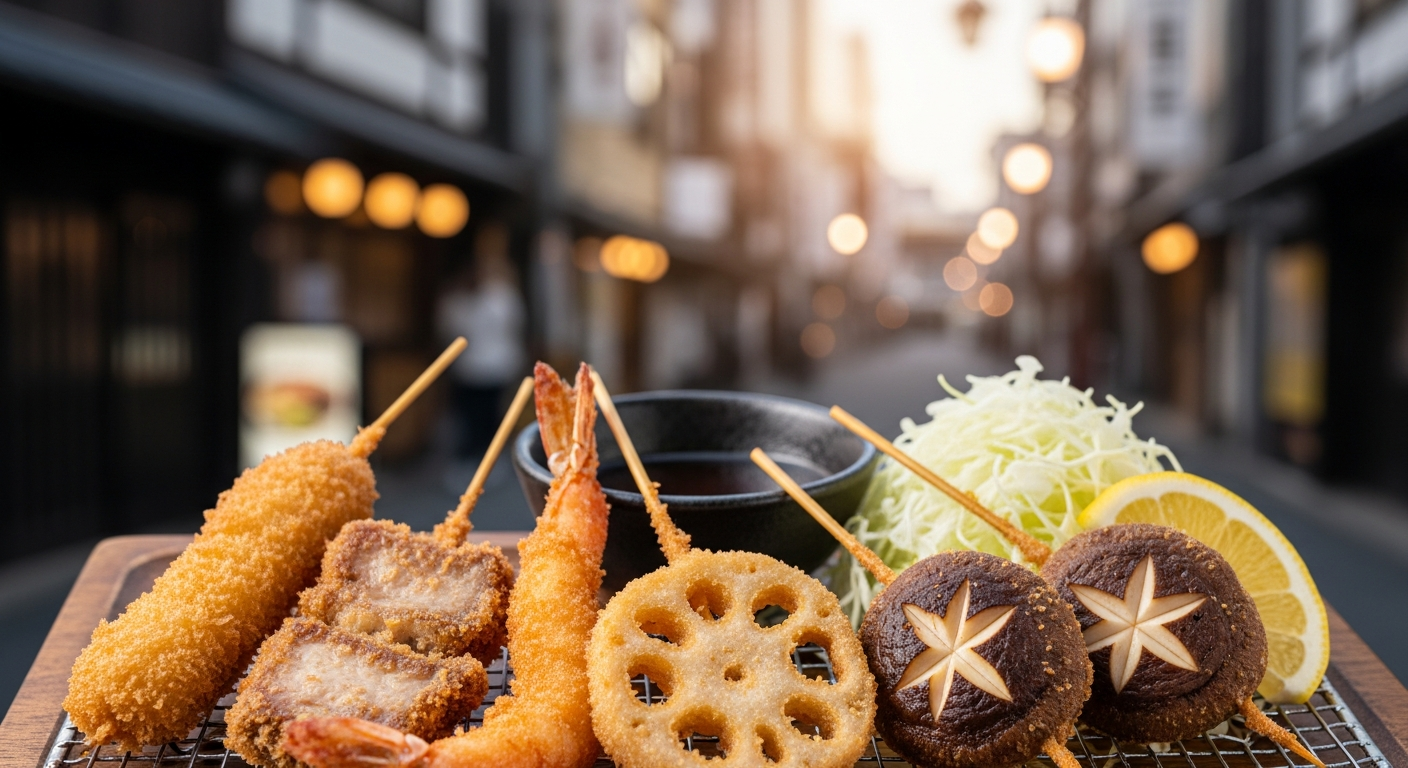
What to order: Omakase 10-skewer set (¥1,500 approx.) or the cheese fondue kushikatsu set
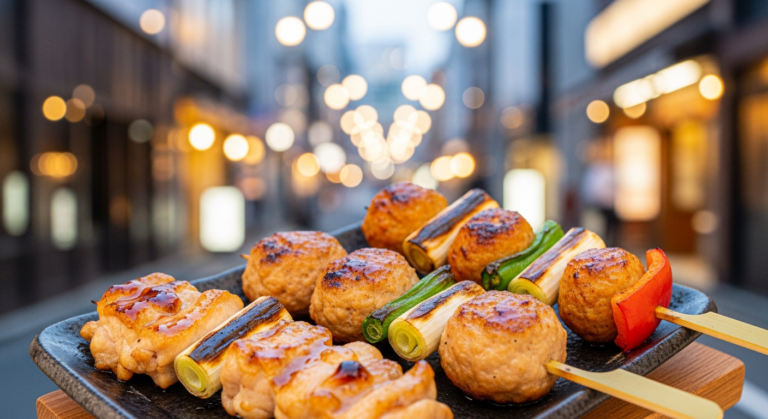
This is the easiest entry point into Tanimachi kushikatsu — one minute from the station exit, no reservations needed on weeknights, and a menu of 40-plus skewer varieties that covers everything from tiger prawn to seasonal vegetables. The house sauce is mild and slightly sweet, and the batter stays genuinely crisp. It’s an izakaya at heart, so expect noise, cold draft beer, and a room full of people who just finished work.
2. Tengu Daihoru Tanimachi 4-chome (てんぐ大ホール 谷町四丁目店)
- 📍 3F, 3-5-5 Tanimachi, Chuo-ku, Osaka-shi, Osaka 540-0012 (Tanisan Kaikan Building)
- 🕐 Mon–Fri 15:00–23:00 / Sat 15:00–22:30 / Sun & Holidays 15:00–22:00 (as of May 2026)
- 💰 ¥1,500–2,500 per person (food only) / ¥2,500–4,000 (with drinks)
- 🚃 Tanimachi 4-chome Station (3 min walk)
- 🗺 Open in Google Maps
- 📋 Tabelog
What to order: Kushikatsu assortment plate (¥800–1,200 approx.) with a draft beer (¥500–600)
Third floor of a slightly tired office building, open from 3pm — which tells you exactly what kind of place this is. Tengu Daihoru is the old-school hall option: big tables, no fuss, the kind of spot where a solo diner with a beer and a plate of skewers fits in perfectly. It opens earlier than most competitors, making it a good call if you want to eat before the dinner rush or are coming straight from Osaka Castle in the afternoon.
3. Kushikatsu Enjiru Tenmabashi (串カツ専門店 縁日 天満橋店)
- 📍 1F, 2-1-2 Uchihiranomachi, Chuo-ku, Osaka-shi, Osaka 540-0037 (IS Building)
- 🕐 Mon–Fri Lunch 11:00–14:00 / Mon–Fri Dinner 17:00–22:00 (as of May 2026)
- 💰 ¥1,500–2,500 per person (food only) / ¥2,500–4,000 (with drinks)
- 🚃 Tenmabashi Station (5 min walk) / Tanimachi 4-chome Station (6 min walk)
- 🗺 Open in Google Maps
- 📋 Tabelog
What to order: Seasonal skewer course — 12 skewers, a closing dish, and dessert (¥3,300)
This is the most considered of the three. Enjiru is a specialist shop — a sister branch of the Umeda original — where each skewer is fried individually and timed to arrive at the table in sequence. The menu runs to 45 varieties, with an emphasis on fresh seafood and seasonal produce. The room is quieter than Hibikiya, the pace is slower, and the ¥3,300 course (12 skewers plus a closing dish and dessert) is genuinely good value for what you get. Worth booking ahead on weekends. The MICHI Osaka travel guide has more on the Tenmabashi neighbourhood if you’re planning a full evening in the area.
How to Order
Kushikatsu is straightforward once you know the one rule: no double-dipping in the communal sauce pot. You dip once, eat, move on. If you want more sauce, use the cabbage leaves provided to scoop it onto your skewer — that’s the accepted workaround. Shouting at the staff about it is not.
At all three spots in this guide, you can order skewers individually (a la carte) or go with a set. Sets are usually better value and take the decision-making off your plate — useful if you’re not sure what to order or if the menu is Japanese-only. Point at the set price on the menu and hold up fingers for the number of people. It works every time.
Skewers arrive hot and should be eaten immediately. Don’t let them sit. The batter goes soft within a couple of minutes and the whole point is the contrast between the crisp exterior and the hot filling inside.
At Hibikiya and Tengu, you can also order oden (simmered dishes) and other izakaya sides alongside your skewers — useful for pacing a longer session. At Enjiru, the course format handles pacing for you.
Most of these spots are cash-friendly, but Hibikiya accepts major credit cards. Bring ¥3,000–5,000 per person and you’ll be fine at any of them.
FAQ
Q: Is kushikatsu in Tanimachi expensive?
A: No. Budget ¥1,500–2,500 per person for food alone, or ¥3,000–5,000 if you’re drinking. The ¥3,300 course at Enjiru is the priciest option here and still represents solid value for 12 skewers plus extras. Hibikiya and Tengu are cheaper, especially if you stick to a la carte.
Q: Do these shops have English menus?
A: Not reliably. Enjiru’s course format is the easiest to navigate without Japanese — just point at the course price. At Hibikiya and Tengu, photo menus help, and pointing at what other tables are eating is always a valid strategy. Google Translate’s camera function handles most Japanese menus adequately.
Q: When is the best time to visit?
A: Weekday evenings between 17:30 and 19:00 are the sweet spot — the after-work crowd is there, which gives the room energy, but it hasn’t peaked yet. Weekends get busier, especially at Enjiru, where a reservation is worth making. Tengu opens at 15:00, making it the best option for an early afternoon snack after sightseeing.
Information is accurate as of May 2026. We recommend checking Google Maps for the latest hours and prices before visiting.