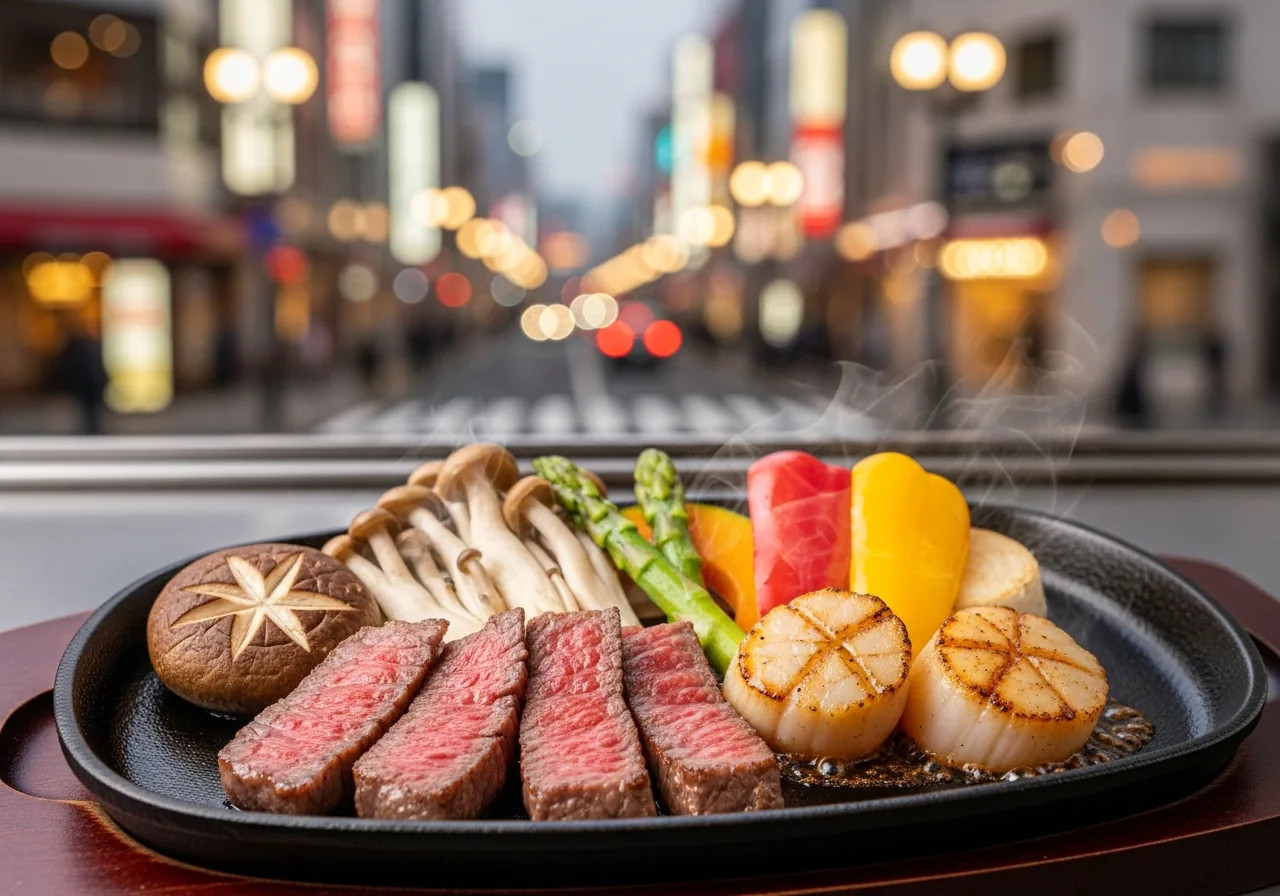
Looking for teppanyaki in Umeda, Osaka? This guide covers eight iron-plate restaurants across the area — from a 1956-founded steakhouse on the top floor of the Hankyu Grand Building to a casual Kobe beef counter near Ohatsu Tenjin. Whether you want a full wagyu course for a special occasion or a quick lunch at the counter, there’s a plate here for you.
MICHI’s Pick — Selected by our Osaka-based team, based on places we’ve visited and on research using Tabelog and Google Maps ratings. In Japan, a Tabelog score of 3.4+ is genuinely high — Japanese reviewers are famously strict, and most locals consider anything above 3.4 a place worth a detour. We feature venues meeting at least one of: Tabelog 3.4+, Google Maps 4.3+, or 100+ reviews — the kind of spots locals quietly trust.
Tabelog and Google Maps scores are accurate as of the time of writing.
1. New Matsusaka Umeda Hankyu Grand Building (ニュー松坂 梅田阪急グランドビル店)
📍 1-35-3 Umeda, Kita-ku, Osaka (Hankyu Grand Building 28F)
🕐 Lunch 11:30–14:30, Dinner 17:00–22:00 (as of May 2026)
💰 ¥5,000–¥10,000 (lunch) / ¥10,000–¥20,000 (dinner, food only)
🚃 Osaka/Umeda Station (3 min walk)
🗣 English menu: Available
⭐ Rating: Tabelog 3.55 / Google 4.2 (320+ reviews) (as of writing)
🗺 Open in Google Maps
📋 Tabelog
What to order: Kobe beef fillet steak course (¥12,000–¥18,000)
Founded in 1956, this is the teppanyaki institution that Osaka regulars bring out-of-town guests to impress. The 28th-floor perch in the Hankyu Grand Building gives you city views alongside your wagyu — book a window counter seat when you reserve. Lunch sets are a genuine bargain for the quality, and the chefs have been doing this long enough that the showmanship feels earned rather than performed. If you want to explore the best food in Osaka, this is a strong starting point for the Umeda teppanyaki scene.
2. Teppanyaki Chayamachi (鉄板焼 茶屋町)
📍 8-1 Kakudacho, Kita-ku, Osaka (Hotel Hankyu International 2F)
🕐 Lunch 11:30–14:00 (last order 13:30), Dinner 17:30–21:30 (last order 20:30) (as of May 2026)
💰 ¥5,000–¥8,000 (lunch) / ¥15,000–¥30,000 (dinner, food only)
🚃 Osaka/Umeda Station (5 min walk)
🗣 English menu: Available
⭐ Rating: Tabelog 3.52 / Google 4.3 (180+ reviews) (as of writing)
🗺 Open in Google Maps
📋 Tabelog
What to order: Kobe beef course (¥18,000–¥25,000 dinner) / wagyu lunch set (¥6,000–¥8,000)
The Hotel Hankyu International address might make you expect stiff formality, but Teppanyaki Chayamachi runs a warmer room than you’d guess. Private counter rooms seat groups of four to eight exclusively around their own iron plate — the chef cooks only for your table, which makes it genuinely good for a business dinner or anniversary where you don’t want strangers watching you eat. Kobe beef is the headline, and the lunch sets are among the most accessible entry points to hotel-grade teppanyaki in the city.
3. Osaka Teppanyaki Kobe Beef TATARA (大阪鉄板焼き 神戸牛 TATARA)
📍 2-3-9 Sonezaki, Kita-ku, Osaka (3F)
🕐 Dinner 17:00–23:00 (last order 22:00) (as of May 2026)
💰 ¥6,800–¥15,000 (dinner, food only)
🚃 Higashi Umeda Station (1 min walk)
⭐ Rating: Tabelog 3.42 / Google 4.3 (90+ reviews) (as of writing)
🗺 Open in Google Maps
📋 Tabelog
What to order: Saison Course with A5 wagyu fillet and branded beef comparison (¥9,500)
TATARA opened in late 2024 on the Ohatsu Tenjin shopping street, and it’s already pulling in a crowd that skews younger than the hotel teppanyaki rooms nearby. The open counter wraps in two configurations — a straight bar and a U-shape — and the chef works both simultaneously, which keeps the energy up. The ¥9,500 Saison Course is the sweet spot: eleven dishes including sea urchin amuse, a cold tomato soup, and a side-by-side comparison of two wagyu cuts. Reservation is essentially mandatory.
4. Akashiro Hankyu Sanbangai (赤白 阪急三番街店)
📍 1-1-3 Shibata, Kita-ku, Osaka (Hankyu Sanbangai B2F)
🕐 Mon–Fri 11:30–15:00 / 17:00–23:00, Sat–Sun 11:30–23:00 (as of May 2026)
💰 ¥1,500–¥3,000 (lunch) / ¥4,000–¥8,000 (dinner, food only)
🚃 Osaka/Umeda Station (directly connected)
⭐ Rating: Tabelog 3.61 / Google 4.2 (400+ reviews) (as of writing)
🗺 Open in Google Maps
📋 Tabelog
What to order: Daikon with porcini cream sauce (¥240) / egg with smoked salmon and herb sauce (¥250)
This is the Umeda teppanyaki spot that food writers keep coming back to, and it earned a place on the Tabelog Steak & Teppanyaki West 100 Best list for 2024. The concept is French-inflected: think confit-style vegetables, porcini cream, and oden cooked in consommé — all finished on the iron plate at a counter-only room of 41 seats. It’s underground in Hankyu Sanbangai, which means you can walk straight in from the station concourse. Dishes are priced individually and portions are small, so order several and share.
5. Ikoku Ichijo (異国一条)
📍 1-9-26 Sonezaki, Kita-ku, Osaka (2F)
🕐 Mon–Sat 17:00–24:00, Sun 17:00–23:00 (as of May 2026)
💰 ¥2,500–¥5,000 (dinner, food only)
🚃 Higashi Umeda Station (4 min walk)
⭐ Rating: Tabelog 3.38 / Google 4.4 (150+ reviews) (as of writing)
🗺 Open in Google Maps
📋 Tabelog
What to order: Italian-style creative okonomiyaki (¥1,200–¥1,600) / teppan-grilled seasonal vegetables
A short walk from Ohatsu Tenjin, Ikoku Ichijo blends Italian technique with Osaka teppanyaki in a way that sounds gimmicky but actually works. The okonomiyaki here uses a lighter batter than the Dotonbori standard, and the kitchen finishes dishes with olive oil and fresh herbs rather than the usual sweet sauce. It’s been featured in the gourmet magazine Amakara Techo and draws a mix of office workers, couples, and the occasional food-curious tourist who wandered off the main drag. Casual enough to drop in without a reservation on a weeknight.
6. Chibo Umeda (千房 梅田店)
📍 1-5-4 Nakanoshima, Kita-ku, Osaka (Chibo Building 1F)
🕐 Mon–Fri 11:30–14:30 / 17:00–22:00, Sat–Sun 11:30–22:00 (as of May 2026)
💰 ¥1,500–¥3,000 (lunch) / ¥4,000–¥8,000 (dinner, food only)
🚃 Oebashi Station (3 min walk) / Nishi Umeda Station (8 min walk)
🗣 English menu: Available
⭐ Rating: Tabelog 3.45 / Google 4.2 (500+ reviews) (as of writing)
🗺 Open in Google Maps
📋 Tabelog
What to order: Premium black wagyu teppanyaki set (¥4,500–¥6,000) / okonomiyaki (¥1,200–¥1,800)
Chibo has been running teppanyaki and okonomiyaki in Osaka for over 50 years, and the Umeda location near Nakanoshima is one of the more relaxed rooms in the chain — wide booths, a proper iron plate at each table, and a menu that covers both the classic Osaka-style okonomiyaki and a full wagyu teppanyaki course. It’s the right call when your group can’t agree on whether they want a casual dinner or something a bit more substantial. English menus are available, and the staff are used to international guests. To explore more of Umeda, Chibo’s location near the Nakanoshima riverfront puts you close to some of the city’s best evening walks.
7. Teppanyaki Wagyu Homura (夜景×鉄板焼 和牛 焔 ~HOMURA~)
📍 1-35-3 Umeda, Kita-ku, Osaka (Hankyu Grand Building 27F)
🕐 Dinner 17:00–23:00 (last order 22:00) (as of May 2026)
💰 ¥8,000–¥20,000 (dinner, food only)
🚃 Osaka/Umeda Station (3 min walk)
⭐ Rating: Tabelog 3.44 / Google 4.3 (120+ reviews) (as of writing)
🗺 Open in Google Maps
📋 Tabelog
What to order: Noto wagyu course (¥12,000–¥18,000)
One floor below New Matsusaka in the same Hankyu Grand Building, Homura is the newer, sleeker alternative — all dark wood, candlelight, and panoramic city views from the 27th floor. The focus is Noto beef, a rare Kuroge Wagyu breed from Ishikawa Prefecture that has a leaner, more mineral flavour than the heavily marbled Kobe cuts you’ll find elsewhere. It’s dinner-only and reservation-recommended, but the wine list is well-chosen and the sommelier actually knows what they’re talking about. A good pick if you want the view without the institution.
8. Iguchi (いぐち)
📍 1-8-12 Sonezaki Shinchi, Kita-ku, Osaka
🕐 Mon–Sat 17:30–22:30 (last order 21:30), closed Sunday (as of May 2026)
💰 ¥15,000–¥30,000 (dinner, food only)
🚃 Kitashinchi Station (3 min walk) / Nishi Umeda Station (5 min walk)
⭐ Rating: Tabelog 3.69 / Google 4.5 (220+ reviews) (as of writing)
🗺 Open in Google Maps
📋 Tabelog
What to order: Matsusaka beef course (¥20,000–¥30,000)
Iguchi is the room that serious teppanyaki eaters in Osaka mention when they’re not trying to impress anyone. It sits in Kitashinchi — Osaka’s high-end dining district — and holds a place on the Tabelog Steak & Teppanyaki West 100 Best list. The chef uses a custom-built oven to grill Matsusaka beef and premium Kuroge Wagyu from across Japan, and the red-meat-forward menu is a deliberate counterpoint to the heavily marbled cuts that dominate the city’s teppanyaki scene. Booking weeks ahead is standard; walk-ins are essentially impossible. The MICHI Osaka travel guide covers more of the Kitashinchi dining scene if you’re planning a full evening in the area.
FAQ
Q: What is the best teppanyaki in Umeda, Osaka?
A: For a special-occasion dinner, Iguchi in Kitashinchi is the most respected room in the area — Tabelog 3.69 and a consistent presence on the West 100 Best list. For a more accessible experience with great views, New Matsusaka in the Hankyu Grand Building (28F) has been doing this since 1956 and offers solid lunch sets from around ¥5,000.
Q: How many teppanyaki restaurants are in Umeda?
A: Tabelog lists around 15 teppanyaki-focused venues in the Osaka Station, Umeda, and Kitashinchi area. They cluster in three zones: the Hankyu Grand Building (high-floor views), the Ohatsu Tenjin / Higashi Umeda strip (more casual, counter-style), and Kitashinchi (high-end, reservation-only).
Q: Do Umeda restaurants have English menus?
A: It varies. Hotel restaurants like Teppanyaki Chayamachi and chain venues like Chibo reliably offer English menus. Smaller independent spots — Iguchi, Ikoku Ichijo, TATARA — may not have printed English menus, though staff at TATARA are accustomed to international guests and can walk you through the courses. Booking via Tabelog’s English platform often lets you specify dietary requirements in advance.
Q: What should I order at teppanyaki restaurants in Osaka?
A: Kobe beef and Matsusaka beef are the two wagyu names you’ll see most often — both are worth trying if budget allows. At mid-range spots, look for the chef’s course (omakase-style, usually 8–12 dishes) rather than ordering à la carte; it gives you a better sense of what the kitchen does well. At casual counters like Akashiro, the individually priced vegetable dishes — daikon with porcini cream, whole tomato with genovese — are the real draw.
Last updated: August 15, 2026 · Corrections: [email protected]