Last updated: July 19, 2026
This article reflects information available at the time of writing. Check Google Maps for the latest hours and availability.
Introduction
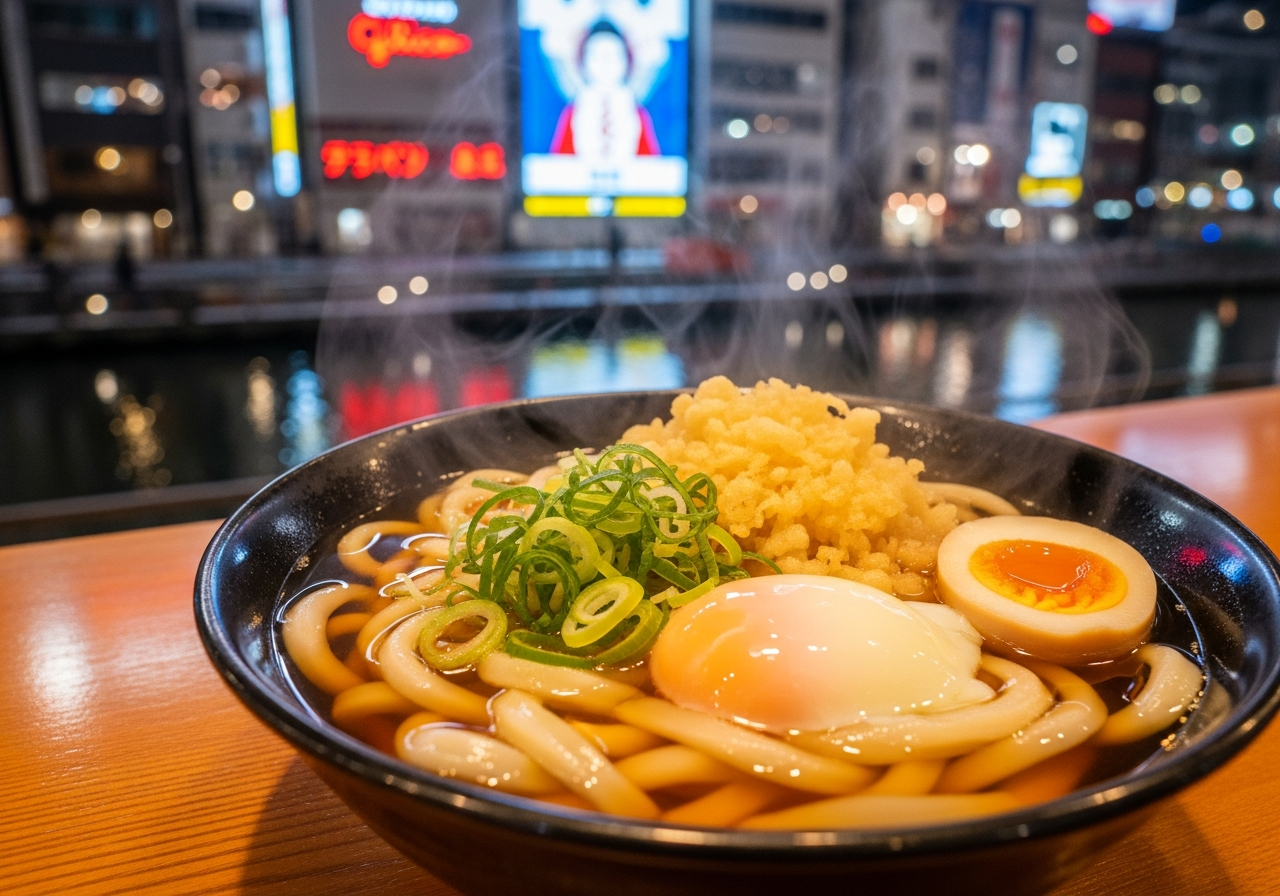
Dotonbori isn’t all bright lights and tourist chaos — it also hides some genuinely comforting udon, especially after dark. Most visitors are here for takoyaki and the Glico photo; the bowls worth knowing about are off to the side. Osaka udon isn’t the chewy Sanuki style you may know — it’s softer, with thick noodles in a delicate, kelp-forward broth that shops here have been refining for decades.
Below are five shops where the neon falls away and what’s in front of you is the actual point: properly made dashi, noodles with character, and the kind of quiet excellence that keeps locals coming back. From long-standing names that have held their line in a tourist-heavy district to standing counters where you eat elbow-to-elbow with salarymen, these bowls are proof that real comfort food survives even in the busiest part of Osaka.
1. Dotonbori Imai Main Store (道頓堀 今井 本店)
- 📍 1-7-22 Dotonbori, Chuo Ward, Osaka
- 🕐 Monday & Tuesday & Thursday – Sunday 11:30 – 20:30(L.O.20:00) (as of May 2026)
- 💰 Budget per person: ¥1,000–2,000 (food only)
- 🚃 Namba Station (1 min walk)
- 🗣 English menu: Available
- 🗺 Open in Google Maps
- 📋 Tabelog
- 🌐 Official site
What to order: Kitsune udon (¥880)
A long-standing Dotonbori udon shop — nearly 80 years in, still pulling out soft noodles in a clear kelp-driven broth. The dashi runs on Hokkaido kombu and mackerel-and-sardine flakes from Kyushu, which is how the broth ends up rich and full of umami while reading light and refined.
2. Ki Datake Udon (き田たけうどん)
- 📍 2-4-17 Namba-naka, Naniwa Ward, Osaka
- 🕐 11:00 – 15:00 (as of May 2026)
- 💰 Budget per person: ¥800–1,200 (food only)
- 🚃 Namba Station (4 min walk)
- 🗣 English menu: Not available
- 🗺 Open in Google Maps
- 📋 Tabelog
What to order: Tori-ten bukkake (¥1,000)
The thin noodles are smooth and silky with just enough chew, and the dashi reads much heavier than a Kanto-style bukkake. The three chicken-tempura pieces on top are seriously oversized — tender breast meat that somehow stays moist at that scale.
3. Chitose Main Store (千とせ 本店)
- 📍 8-1 Nanba Sennichimae, Chuo Ward, Osaka
- 🕐 10:30–14:30 (sold out closure) (as of May 2026)
- 💰 Budget per person: ¥800–1,200 (food only)
- 🚃 Namba Station (5 min walk)
- 🗣 English menu: Not available
- 🗺 Open in Google Maps
- 📋 Tabelog
What to order: Niku-sui (tofu included) (¥850) + Kodama (egg rice) (¥200)
Finely cut beef, a heap of chopped green onion, and a poached egg hiding underneath. The dish came about when Yoshimoto New Comedy’s Hanakikyo turned up hungover and asked for “niku udon, hold the udon” because he wanted something easier on the stomach.
4. Namba Udon (なんばうどん)
- 📍 3-2-14 Namba, Chuo Ward, Osaka
- 🕐 11:00–21:00 (as of May 2026)
- 💰 Budget per person: ¥200–500 (food only)
- 🚃 Namba Station (E5 exit immediately)
- 🗣 English menu: Not available
- 🗺 Open in Google Maps
- 📋 Tabelog
What to order: Tempura udon (¥240)
A genuinely shocking price point — kake udon is ¥170. Tucked just inside the Nankai-dori arcade, the bowls are unreasonably cheap, but the dashi tastes far better than it has any right to.
5. Matsuya (松屋)
- 📍 3-1-17 Namba, Chuo Ward, Osaka
- 🕐 6:00–23:00 (open daily) (as of May 2026)
- 💰 Budget per person: ¥300–600 (food only)
- 🚃 Namba Station (3 min walk)
- 🗣 English menu: Not available
- 🗺 Open in Google Maps
- 📋 Tabelog
What to order: Kasu udon (¥350)
Open from 6am daily, no closures, 20 seats, electronic money accepted. The signature kasu udon comes with crispy beef-intestine cracklings that load richness into the light Kansai-style broth — a local favourite you don’t run into much in the tourist zone.
How to Order
Ordering is mostly the same across these shops, with a few wrinkles. At standing counters like Namba Udon, decide before you reach the front — “udon ka soba?” (udon or soba?) is usually the opening question. Cash first at most, though the newer places take IC cards.
At table-service shops like Imai, wait to be seated and order off the menu. Pointing is fine if your Japanese is limited. Many places offer sizes: “futsu” (regular) or “o-mori” (large). At Chitose, arrive early — they close once the broth runs out, often by 2pm on busy days.
Standing-counter etiquette: eat at pace but don’t rush. Slurping is expected and actually opens up the flavour. At counter shops, push your empty bowl toward the back when you’re done. Most places pour free iced water and hot tea — ask for “mizu” or “ocha.”
FAQ
Q: Is udon in Dotonbori expensive?
A: It’s surprisingly affordable. Standing shops run ¥200–500; sit-down places sit at ¥800–2,000. Even the famous Dotonbori Imai stays reasonable at ¥1,000–2,000 per person.
Q: Do shops in Dotonbori have English menus?
A: Tourist-facing spots like Dotonbori Imai have English menus; most local favourites don’t. Picture menus are common, and pointing works well. Useful terms: “kitsune” (fried tofu), “tempura” (mixed fritters), “niku” (meat).
Q: When is the best time to visit?
A: Skip the 12–1pm lunch rush for shorter waits. Chitose really does need an early start (opens 10:30am) since they close when the broth runs out. Evenings (6–8pm) are calmer overall, especially at the standing counters that pull the after-work crowd.
Information is accurate as of May 2026. We recommend checking Google Maps for the latest hours and prices before visiting.