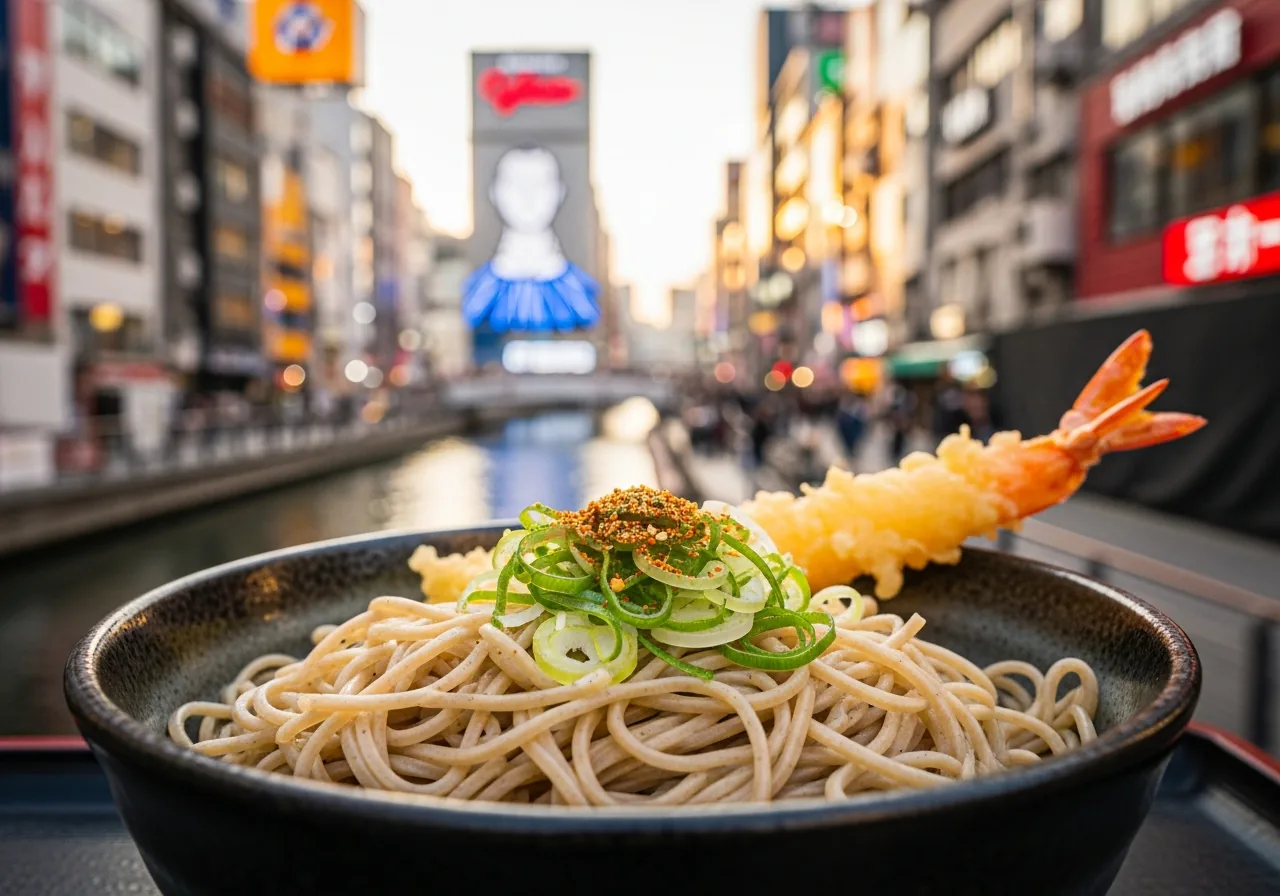
Looking for soba in Dotonbori, Osaka? This stretch of the city has more buckwheat noodle options than most visitors expect — from a Tabelog Hyakumeiten-listed counter overlooking the canal to a 1957-founded institution doing soba-shabu, plus a juwari specialist and a Michelin-recognised shop a short walk away. Five shops, all currently operating, covering lunch counters and evening izakaya-style dining.
MICHI’s Pick — Selected by our Osaka-based team, based on places we’ve visited and on research using Tabelog and Google Maps ratings. In Japan, a Tabelog score of 3.4+ is genuinely high — Japanese reviewers are famously strict, and most locals consider anything above 3.4 a place worth a detour. We feature venues meeting at least one of: Tabelog 3.4+, Google Maps 4.3+, or 100+ reviews — the kind of spots locals quietly trust.
Tabelog and Google Maps scores are accurate as of the time of writing.
1. Teuchi Soba Hoshi (手打ちそば 星)
📍 1-1-9 Dotonbori, Chuo-ku, Osaka (Hoei Building 1F)
🕐 Lunch 12:00–14:30, Dinner 18:00–20:30; closed Tuesdays (as of May 2026)
💰 ¥1,500–¥2,500 (food only)
🚃 Nippombashi Station (5 min walk)
🗣 English menu: Yes
⭐ Rating: Tabelog 3.72 / Google 4.3 (280+ reviews) (as of writing)
🗺 Open in Google Maps
📋 Tabelog
What to order: Kamo-jiru zaru (¥1,700) or Ten-kamo nanbam (¥2,200)
This Tabelog Soba WEST Hyakumeiten 2024 pick sits right on the Dotonbori-gawa strip, with a soba-rolling board visible near the entrance and a back window that frames the canal. The menu comes in English, with an illustrated guide on how to eat soba — a rare and genuinely useful touch in this part of town. The noodles are ni-hachi (80% buckwheat, 20% wheat), rolled fresh each morning from Fukui-prefecture grain; the duck broth is built on Kawachi aigamo, rich enough to drink straight. If you want to understand what good Osaka soba actually tastes like, start here. For more ideas on what to eat in the area, see the best food in Osaka.
2. Sohonke Naniwa Soba (総本家 浪花そば)
📍 1-7-26 Dotonbori, Chuo-ku, Osaka
🕐 Lunch 11:30–15:00, Dinner 17:00–22:00; open daily (as of May 2026)
💰 ¥1,200–¥4,000 (food only) / ¥2,500–¥6,000 (with drinks and soba-shabu course)
🚃 Namba Station (5 min walk)
⭐ Rating: Tabelog 3.3 / Google 4.1 (190+ reviews) (as of writing)
🗺 Open in Google Maps
📋 Tabelog
🌐 Official site
What to order: Soba-shabu course (from ¥3,500 per person)
Founded in 1957, Naniwa Soba mills its own buckwheat in-house and built its reputation on soba-shabu — thin-sliced beef swirled through a hot dashi broth alongside handmade noodles. It’s the kind of format you won’t find at most soba counters, and it makes the place worth knowing about for groups or anyone who wants a proper sit-down dinner rather than a quick lunch. The tatami-adjacent interior feels genuinely old Osaka, not reconstructed-for-tourists old.
3. Genji Soba (源氏そば)
📍 1-7-17 Dotonbori, Chuo-ku, Osaka
🕐 11:30–21:00 (last order 20:30); closed Wednesdays (as of May 2026)
💰 ¥1,100–¥2,400 (food only)
🚃 Namba Station (6 min walk)
⭐ Rating: Tabelog 3.2 / Google 4.2 (150+ reviews) (as of writing)
🗺 Open in Google Maps
📋 Tabelog
What to order: Juwari soba (100% buckwheat, ¥2,400) or mori soba (¥1,100)
Genji Soba serves both ni-hachi and juwari (100% buckwheat) noodles, handmade in the Kansai tradition and popular with locals and visitors alike — including a solid vegan-friendly selection. Regulars come specifically for the juwari soba, returning whenever they’re in town. The 100% buckwheat version is earthier and more fragile than the blended noodle — it snaps rather than stretches — and at ¥2,400 it’s the honest way to taste what buckwheat actually does on its own.
4. Naniwa Okina (なにわ翁)
📍 2-7-17 Soemoncho, Chuo-ku, Osaka
🕐 Lunch 11:30–14:30, Dinner 17:30–21:00; closed Sundays and public holidays (as of May 2026)
💰 ¥1,500–¥3,500 (food only)
🚃 Namba Station (7 min walk)
⭐ Rating: Tabelog 3.6 / Google 4.4 (200+ reviews) (as of writing)
🗺 Open in Google Maps
📋 Tabelog
What to order: Nishin soba (herring soba, ¥1,600) or ten-zaru (¥2,200)
Naniwa Okina serves handmade buckwheat noodles and is particularly known for its nishin soba with sea herring — and it holds a Michelin star. That recognition hasn’t inflated the prices or the attitude: this is still a compact, no-fuss counter where the focus is entirely on the noodle. The herring soba is the dish to order — the fish is slow-simmered until it collapses into the broth, and the result is deeply savoury in a way that feels specific to Osaka. Worth the short walk from the main Dotonbori strip. To plan your full visit around the neighbourhood, explore more of Dotonbori.
5. Soba Dining Tsurukame (そばダイニング 鶴亀)
📍 1-6-12 Dotonbori, Chuo-ku, Osaka
🕐 Lunch 11:30–15:00, Dinner 17:00–23:00; open daily (as of May 2026)
💰 ¥900–¥2,000 (food only) / ¥2,000–¥4,000 (with drinks)
🚃 Namba Station (4 min walk)
⭐ Rating: Tabelog 3.1 / Google 4.0 (120+ reviews) (as of writing)
🗺 Open in Google Maps
📋 Tabelog
What to order: Mori soba set with mini-donburi (¥1,200–¥1,500)
The most accessible entry point on this list — a casual soba-and-izakaya hybrid that stays open through the afternoon and into the night, which matters in a neighbourhood where most dedicated soba counters close by 3pm. The soba is machine-assisted rather than fully hand-rolled, but the dashi is made in-house and the lunch sets are honest value. Good for a solo traveller who wants a bowl and a beer without ceremony. The MICHI Osaka travel guide has more on navigating the area’s eating hours.
6. Shinshu Soba Mugimaru (信州そば 麦丸)
📍 2-8-25 Namba, Chuo-ku, Osaka (near Hozenji Yokocho)
🕐 11:00–22:00 (last order 21:30); open daily (as of May 2026)
💰 ¥850–¥1,800 (food only)
🚃 Namba Station (5 min walk)
⭐ Rating: Tabelog 3.2 / Google 4.1 (180+ reviews) (as of writing)
🗺 Open in Google Maps
📋 Tabelog
What to order: Mori soba (¥850) or kake soba (¥900)
This spot serves authentic Shinshu soba made in-house, paired with a rich golden dashi broth. Shinshu (Nagano-prefecture) buckwheat has a slightly greener, more aromatic character than Fukui grain — the difference is subtle but real if you’re eating your way through the list. At ¥850 for a mori, it’s the most affordable bowl in this article, and the long hours mean it works as a late-afternoon stop when the dedicated lunch counters have already shut their doors.
FAQ
Q: What is the best soba in Dotonbori, Osaka?
A: Teuchi Soba Hoshi is the standout — a Tabelog Hyakumeiten 2024 selection with a canal-side window, Fukui-grain ni-hachi noodles rolled fresh daily, and an English menu. The kamo-jiru zaru at ¥1,700 is the dish to order. For a Michelin-level experience a short walk away, Naniwa Okina’s nishin soba is equally worth the detour.
Q: How many soba restaurants are in Dotonbori?
A: Tabelog lists around 44 soba spots across the broader Namba, Nihonbashi, and Dotonbori area. Dedicated handmade-soba counters are fewer — roughly eight to ten — and they cluster along the Dotonbori-gawa strip and the Hozenji Yokocho backstreets. Most are small, with 10–20 seats.
Q: Do Dotonbori restaurants have English menus?
A: It varies. Teuchi Soba Hoshi has a confirmed English menu with an illustrated soba-eating guide. Most other soba counters in the area operate Japanese-only menus, though photo menus are common and staff at tourist-facing spots will generally manage basic English. Pointing at neighbouring tables works fine everywhere.
Q: What should I order at soba restaurants in Osaka?
A: Start with zaru soba (cold noodles with dipping broth) to taste the buckwheat clearly — it’s the format that shows off a shop’s noodle quality most honestly. Kamo-jiru zaru (duck dipping broth) is the Osaka upgrade worth paying for. If you want something hot, kake soba (noodles in broth) or kitsune soba (with fried tofu) are the reliable classics.
Last updated: July 28, 2026 · Corrections: [email protected]