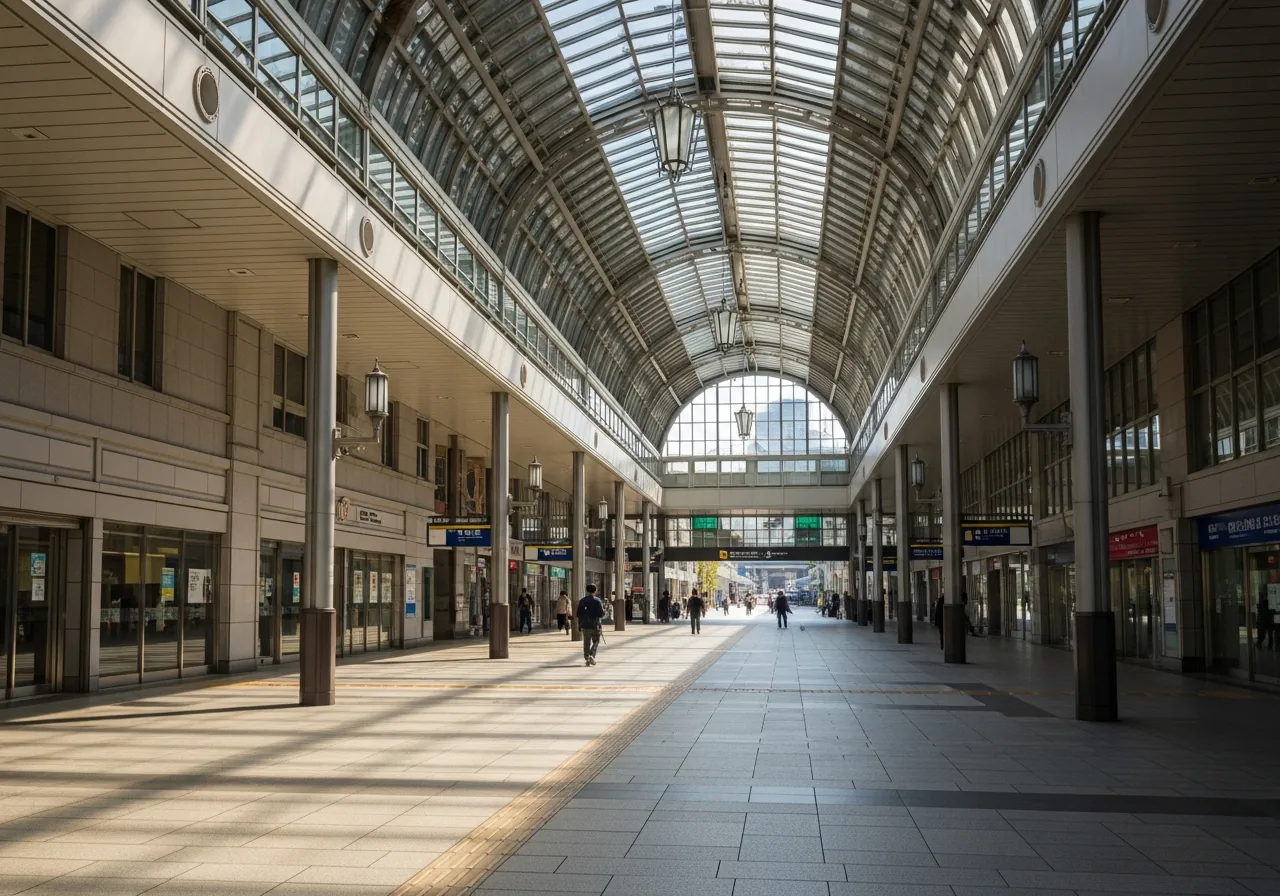
Osaka Station has been rebuilt five times since it opened on 11 May 1874 — not because of carelessness, but because each successive structure was a direct answer to a crisis: the wrong location, the wrong capacity, a war that stripped the steel from its walls, a national railway on the verge of bankruptcy, and finally a freight yard that had sat like a locked door at the city’s most valuable address for nearly a century. The station’s five lives are, in sequence, the five chapters of modern Osaka’s own biography.
Why we can tell you this — MICHI is written and edited in Osaka; our team walks through Osaka Station City most weeks, and the history panels in the South Gate Plaza are a ten-minute read we have done more than once. This piece draws on the station’s own archival record as presented by OsakaStation.com, the photographic and documentary record at Old Photos of Japan, the corporate history published by Hankyu Hanshin Department Store, and the official project documentation from the Osaka Convention Tourism Bureau on Grand Green Osaka. Where the record is thin — particularly on the precise civilian experience of the postwar black market years — we have said so rather than invented colour.
Stand on the fifth-floor bridge of Osaka Station City on any weekday morning and you are watching something that has no real equivalent in the Western world. Below you, eleven tracks carry trains in six directions simultaneously.
The glass roof overhead — a wave of steel and translucent panels that covers the entire platform zone — turns the ordinary act of catching a train into something that feels, faintly, like standing inside a cathedral. Commuters move through the space with the practiced indifference of people who have long since stopped noticing the architecture.
Tourists stop and look up. Both responses are correct.
What neither group tends to know is that the ground they are standing on was, 150 years ago, a graveyard built on a swamp — and that the decision to put a railway station here rather than somewhere more sensible was one of the most consequential acts of urban planning in Japanese history.
Why Here? The Graveyard at the Edge of the City
The name gives it away, if you know how to read it. The word “Umeda” was previously written with different kanji characters: 埋田, meaning “buried field,” to reflect the area’s history as reclaimed wetland. The name was later changed to 梅田 — “plum field” — without altering the pronunciation, likely because of the negative connotations of the original characters.
The negative connotations ran deeper than mere etymology. In Umeda, there was a historical grave site called Umeda Haka, one of the seven largest cemeteries of Osaka from the Edo period until the first twenty years of the Meiji period.
In 2020, survey teams for the Umekita redevelopment project discovered ancient burial remains of over 1,500 people. Experts say these remains were of commoners, not the aristocracy.
The bones of ordinary Osaka people lay under the ground where the station’s North Gate Building now stands.
So when the Meiji government began planning the Osaka-Kobe railway line in the early 1870s, Umeda was not an obvious choice. It was outside the city limits.
It was wet. It was, in the most literal sense, a place where people went to bury their dead.
The original plan was different. The original plan had been to build a smaller station with a dead-end bay platform further south in the more urban location of Dojima.
This would have been closer to the city’s river transportation network, and just two years before, Japan’s first railway station in Yokohama had been built with the same style of bay platform. Dojima made obvious sense: it was the commercial heart of Osaka, home to the rice futures market, already connected to the city’s canal network.
But the citizens of Dojima did not want a steam locomotive running through their neighbourhood. Planners had intended to place the station in nearby Dojima, near Japan’s most important rice market, but Osaka’s frightened inhabitants were set against it.
They worried that if the fire wagon ran through the tightly built area full of wooden houses it wouldn’t take long before it started a disastrous fire. It was therefore decided to move the graveyard in Umeda, place the station in its stead, and have the tracks run through the then uninhabited wetlands and fields.
Fear of fire, in other words, created one of the great urban centres of modern Japan. The graveyard was cleared.
The wetland was filled. The area was reclaimed and filled in by the prefectural government in the 1870s to support the creation of the first Osaka Station.
And on 11 May 1874, the first Osaka Station opened: a Western-style red brick building just two stories high, situated a little further to the west of the current station, closer to where Osaka Central Post Office stands today.
It is hard to imagine now, but at that time the Umeda area was mostly rice fields, with just a few scattered residences, and it was not even a part of the Osaka municipality. The single road leading to the station ran through paddy fields.
The first stationmaster, according to local lore recorded by Old Photos of Japan, lived only a hundred meters away from his office but reportedly used a jinrikisha — a rickshaw — to cover the distance. Most of the early station employees were of the samurai class, men who took their new industrial roles with the same gravity they had once brought to the sword.
Why a Through Station? The Decision That Made Everything Else Possible
The choice of Umeda over Dojima was not only about fire safety. It was also about engineering ambition.
In order to allow for the line’s eastward expansion, it was decided to adopt a through-station design, and for that more space was required. Choosing both this through-station design and the more open Umeda location would prove crucial to the development of the station as it became an important hub in the expanding national network of railways.
The proof came almost immediately. Just two years after Osaka Station was established, the line was expanded east to connect with Kyoto.
This importance increased further after the Tokaido railway line was finished in 1889, making it possible to travel from Osaka to Shinbashi Station in Tokyo. A dead-end bay platform at Dojima could never have accommodated this.
The through-station at Umeda could, and did.
The gravitational pull of the station on the surrounding area was immediate and total. After the station was placed in Umeda, the area slowly but surely turned into Osaka’s primary transportation hub. Several railways used Osaka Station as their terminal or built their terminal nearby: Osaka Railway in 1895, Nishinari Railway in 1898, Hanshin Electric Railway in 1906, Minoo Arima Electric Tramway (the current Hankyu Railway) in 1910, and the Midosuji Subway in 1933.
Each new line brought more passengers. More passengers brought more commerce.
More commerce brought more lines. The feedback loop that would eventually produce one of the busiest transit nodes on earth had begun in a cleared graveyard on the edge of a rice paddy.
The First Life: Red Brick and Rickshaws (1874–1901)
The first station building was, by all accounts, a charming thing. While the second station looked like an enormous rock, the first station was a very friendly-looking building with a small park in front, featuring a rock-lined pond. Photographs from the 1870s show a neat two-storey structure in the Western style, with rickshaws lined up outside — the old world and the new world in the same frame.
In its early years, the station was known colloquially not as Osaka Station but as “Umeda Sutensho” — a Japanese phonetic approximation of the English word “station.” In Osaka Station’s early days it was familiarly known as “Umeda Eki” or “Umeda Sutensho.” This ceased to be the case as more railway companies were attracted to the area and built their own “Umeda” terminals. The nickname stuck long enough to become a piece of local folklore; the station’s own information panels in the South Gate Plaza still reference it.
The first building handled both passengers and freight. The station initially handled both passengers and freight, but the volume of both increased so dramatically that in 1928 a large freight yard was built — the Umeda Freight Station.
That freight yard would become, decades later, the last great undeveloped plot in central Osaka — and the site of Grand Green Osaka. But that story belongs to the fifth life.
By the turn of the century, the first building was simply too small. At the turn of the century it became clear that new facilities would be needed. To connect the station with the municipal tramline, a broader station front plaza was also necessary, so in 1901 Osaka Station was moved to its current location and housed in a grander stone-clad building.
The Second Life: Stone and Civic Pride (1901–1940)
The second station building was a statement of arrival — not just for the station, but for Osaka itself. In 1901, Osaka Station was moved to its current location and housed in a grander stone-clad building. This new station building became a famous landmark and was renowned as one of the three great modern buildings in Osaka, along with the Osaka Branch of the Bank of Japan built in 1903, and the Japanese Mint’s Senpukan building built in 1871.
The second building presided over Osaka’s most extraordinary period of growth. Osaka Station played a very important role in the industrialization of Osaka, helping to make it Japan’s biggest and richest city during the 1920s and 1930s.
During this time, Osaka was nicknamed the Manchester of the East and proudly called itself the City of Smoke. Children all over Japan learned in their schoolbooks that on approaching Osaka Station, the sky appeared overcast because of all the smoke in the air.
The station was the engine of this industrial machine. From its inception, Osaka Station played a pivotal role in industrial transport, facilitating the movement of goods for the city’s dominant textile sector. The station’s freight yards initially managed raw cotton imports and finished fabrics, supporting Osaka’s emergence as a manufacturing powerhouse, with volumes escalating to necessitate dedicated expansions by the early 20th century.
It was also during the second building’s tenure that the competitive ecosystem of Umeda took shape. The first major challenge to Osaka Station’s predominance was the Hanshin Osaka-Umeda Station, which opened on 21 December 1906.
By that time, many of the country’s major private railways had been nationalized and Osaka Station lay at the hub of several government-run rail lines. Hanshin Electric Railway found a new outlet for competitive private enterprise by applying for permission to build a tramline between Osaka and Kobe.
This new line was in direct competition with the government-run Tokaido line, and would never have received official permission if it had been opened as a railway.
The regulatory sleight of hand — calling a railway a tramline to avoid nationalization — is very Osaka. The city has always found ways around rules that inconvenience commerce.
Then came the invention that would reshape not just Umeda but the entire logic of Japanese urban development. In 1920, the entrepreneur Ichizo Kobayashi leased the first floor of his Hankyu Umeda Station building to the Shirokiya retail company.
Shirokiya was founded in Tokyo’s Nihonbashi district in 1662 and became a modern corporation in 1919, just before opening their store in Umeda. Shirokiya Umeda sold food and other grocery store items, while Hankyu turned the second floor into a large affordable eatery called the “Hankyu Cafeteria.”
The experiment worked. Kobayashi terminated Shirokiya’s lease in 1925 and went further.
In 1925, under the direction of Ichizo Kobayashi, Hankyu Market — the predecessor to Hankyu Department Store — opened in Umeda as a directly managed market division of Hankyu Corporation. In April 1929, Hankyu Department Store was born as the world’s first railway terminal department store.
At the time, many Japanese department stores originated as kimono shops, and there were no examples of railway companies operating department stores directly, even outside of Japan.
“Today, it is not uncommon to find department stores near railway terminal stations around the world, but this originated with Hankyu Department Store, which was born in Umeda, Osaka.” — Hankyu Hanshin Department Store corporate history
The implications of this were enormous. The Hankyu Department Store became the first railway terminal department store, designed to serve several hundred thousand daily commuters, and as such heralded a new wave of Japanese retailers.
This wave was characterized by the opening of department stores by railroad companies on prime sites along the railway lines, in particular at important terminals and main interchange stations. Every department store you see attached to a Japanese railway station today — and there are hundreds of them — traces its lineage to Kobayashi’s experiment in Umeda in 1929.
The second station building was demolished in 1935 to make way for the third. The second station building was dismantled in 1935 to make way for a more modern design, but it wasn’t completely demolished.
Instead, the building’s materials were shipped east and reassembled in Tokyo, where the building housed a school for girls until it was finally destroyed in the 1940s during a wartime air raid. Even in demolition, the second station had a second life.
The Third Life: The Incomplete Station (1940–1979)
The third station was supposed to be a triumph. The opening of the third Osaka Station was planned to coincide with the Tokyo Olympics, which were scheduled to take place in the summer of 1940. Originally designed as a five-story building with a hotel to occupy the top three floors, it was meant to have an imposing, modern, international appearance.
The Tokyo Olympics of 1940 were cancelled. The war came instead.
The outbreak of World War II led to both the cancellation of the Tokyo Olympics and the drastic modification of the station’s building plans, as the army confiscated most of the steel needed for construction. The station was opened in an incomplete state on 1 June 1940, and except for the central part of the building, the upper floors were never completed according to the original plan.
The truncated third station stood through the worst years of the war. Osaka was a primary industrial target.
Osaka was traditionally the most important industrial concentration in the Far East. It was one of the principal centres of heavy industry, noted for its shipbuilding, iron, steel, and rolling stock works, as well as non-ferrous metals enterprises.
The Americans knew this. The raids began in March 1945 and continued until the last day of the war.
Osaka Station was completely destroyed during an air raid on 7 June 1945, as part of the extensive bombing campaigns that devastated much of the city and resulted in over 10,000 civilian deaths across all raids on Osaka. In the immediate postwar years, the ruined station site and surrounding Umeda district became hubs for black market activities, where vendors and traders operated amid the scarcity of goods and the collapse of formal distribution systems following Japan’s surrender.
The black market at Umeda was, by all accounts, a city within the ruins of a city. US air raids destroyed the area in front of the station.
As happened with many other Japanese stations after the end of the war, the bombed-out area was for many years used as an enormous black market where people would go to buy the most basic necessities, as well as otherwise unattainable luxuries. The atmosphere of those years — the improvised commerce, the desperate ingenuity — was, in its way, entirely consistent with Osaka’s character.
The city has always been a trading city. Even in ruins, it traded.
Reconstruction efforts in the 1950s focused on restoring basic functionality to the station, utilizing the framework of the third-generation building originally completed in 1940, which had been heavily damaged but was repaired to support growing passenger traffic during Japan’s economic recovery. The station that emerged from the rubble was functional rather than beautiful — a building that had been designed for a world that no longer existed, patched together to serve a city that was rebuilding itself from nothing.
One decision made during the third station’s tenure deserves particular attention, because it shaped the geography of Osaka in ways that are still felt today. When the Shinkansen was being planned in the late 1950s, the obvious terminus for Osaka was Osaka Station itself.
Shin-Osaka Station was opened on 1 October 1964 to serve the first high-speed Shinkansen bullet trains. Running Shinkansen tracks directly into the Umeda area was judged to be too difficult because of the complex web of competing rail lines that were already in place.
This is why, to this day, Osaka Station does not serve the Shinkansen. The very success of the station — the density of competing lines that had clustered around it over ninety years — made it impossible to add the one line that would have made it the unambiguous centre of Japanese rail travel.
Shin-Osaka, three stops north on the Midosuji subway, became the bullet-train gateway instead. The irony is exquisite: the station’s own gravitational pull had made it too crowded to receive the future.
The Fourth Life: The Department Store That Couldn’t Save a Railway (1979–2011)
The fourth station opened on 15 December 1979. The fourth Osaka Station building opened on 15 December 1979.
At this time the station was still run by Japanese National Railways (JNR), and this national network had long been suffering from serious financial difficulties. In Osaka, to help offset JNR’s debts, they followed the precedent set by Hankyu Railways back in 1929 and built a 27-story department store in the terminal building that stood over the station.
The symmetry is almost too neat. Fifty years after Kobayashi’s private-sector innovation at Hankyu, the failing national railway was copying it in desperation.
This was the Acty Osaka department store, which opened in 1983. The store was successful, but JNR’s debts were overwhelming and the national network was privatized to form the JR Group of railways in 1987.
The privatization of JNR in 1987 was one of the most consequential events in postwar Japanese economic history. The monolithic JNR was dissolved and split in 1987, its expansive trackage and massive train fleets divided between six regional and one freight private Japanese Railways companies.
Osaka Station passed to JR West, the regional company covering the Kansai area. The new company had a commercial mandate that the old national railway had never fully embraced.
But the privatization had another consequence that would take decades to fully unfold. When the Japan National Railways was privatized in 1987, it was decided that the Umeda Freight Station would be relocated, so that the area — the last piece of undeveloped real estate in Osaka’s city centre — could be developed.
The freight yard that had been built in 1928 to handle the station’s industrial traffic had become, by the late twentieth century, an enormous locked door sitting at the most valuable address in western Japan. The decision to move it set in motion a process of redevelopment that is still not complete as of this writing in 2026.
The fourth station building was not unloved, but it was not beautiful. JR Osaka Station used to be among the most unattractive major railway stations in Japan, characterised by narrow, crowded corridors and low ceilings.
It was a building designed by a bureaucratic railway in financial crisis, and it looked like one. The glass-and-steel ambition of the original 1940 design had been replaced by the pragmatic utilitarianism of the 1970s.
Osaka deserved better, and eventually got it.
The Fifth Life: The City Inside the Station (2011–present)
The transformation of Osaka Station into its current form took four years of construction and was completed in 2011. The result was something genuinely new in the history of Japanese railway architecture.
The formerly dark and cramped station underwent extensive renovation works and was reborn in 2011 as Osaka Station City, one of Japan’s most attractive railway stations. Osaka Station City’s landmark is a large glass roof that spans over the railway tracks and gives the station a lot of new open space.
Large buildings on the north and south sides of the station provide travellers with a wide array of shopping, dining, entertainment and recreation opportunities, and are connected with each other by a wide bridge over the railway tracks.
The glass roof is the element that changes everything. The large roof covering the station platform also helps collect rainwater.
It slopes from north to south to channel rainwater to an underground reservoir. The collected water is then used in toilets, for watering plants, and other uses.
Form and function, elegance and engineering, in the same structure.
The fifth-floor bridge — the Toki no Hiroba, or “Time and Space Plaza” — is the station’s great public room. On the fifth floor, the expansive bridge connecting the North Gate and South Gate buildings is decorated with two very large clocks, one gold and one silver, and the plaza’s name “Toki” is written with the characters for “time” and “space.” It is a place where people meet, where tourists photograph the trains below, where office workers eat lunch looking out over the city. It is, in the best sense, a civic space — something the fourth station never managed to be.
The current fifth-generation structure, known as Osaka Station City, was completed in phases between 2007 and 2011, featuring a modern elevated design with integrated shopping malls, offices, hotels, and the iconic Central Gate. The total floor area of the complex is approximately 530,000 square metres, making Osaka Station City one of the largest commercial facilities in Western Japan.
The station’s commercial success — Lucua Osaka, the Daimaru department store, Hotel Granvia — is the direct descendant of Kobayashi’s 1929 insight. The railway and the department store are not separate things; they are the same thing, two faces of a single economic organism. This business model can perhaps be seen as having reached its zenith with the giant Osaka Station City shopping complex that now houses Osaka Station.
Why the Freight Yard Matters: The Sixth Life Beginning Now
The story does not end in 2011. It is, in fact, still being written on the ground north of the station’s tracks.
The Umeda Freight Station — the yard built in 1928 to handle the industrial traffic that the station itself could no longer accommodate — was finally relocated after privatization. The area was the former site of the Umeda Freight Station (known as Umeda North Yard), which served as a railway logistics hub for 85 years.
For decades after the freight trains left, the site sat as a vast, flat, underused expanse immediately north of one of the world’s busiest transit hubs. It was, as one developer put it, “the last remaining premium location in the Kansai region.”
The first phase of its redevelopment — Grand Front Osaka, a row of four skyscrapers with shopping, hotels, and offices — opened in 2013. The second and more ambitious phase is Grand Green Osaka.
Grand Green Osaka is the second phase of a redevelopment project to transform the former trainyards north of Osaka Station into a new, modern city district. Located in Umeda, the primary transportation hub for Osaka and western Japan, the project officially opened its initial area during a September 6, 2024 ceremony.
The scale is extraordinary. Grand Green Osaka and Umekita Park opened to substantial completion on 4 September 2024, and the project will be fully open in spring of 2027. The ¥1 trillion ($7 billion USD) project anticipates attracting 100 million visitors a year.
At the heart of it is Umekita Park — a deliberate inversion of everything the freight yard represented. Umekita Park, central to the redeveloped area, boasts roughly 45,000 square metres of green space and a direct connection to Osaka Station. The park will contribute to not only Osaka’s sustainability initiatives but also to the city’s disaster resilience by providing a wide-area evacuation space.
The park’s designers include Tadao Ando and the firm SANAA — two of the most significant names in contemporary Japanese architecture. The landscape design was led by GGN, with Nikken Sekkei and Mitsubishi Jisho Design as supervising architects, Tadao Ando Architect & Associates responsible for park facilities, and Sejima and Nishizawa and Associates (SANAA) for the large canopy facilities.
The irony of the park’s location is worth sitting with. Previously, Osaka had the lowest amount of greenery per inhabitant of any prefecture in Japan.
The city that built itself on commerce, on smoke, on the relentless logic of trade, is now building a park — a large, expensive, carefully designed park — on the last piece of ground it had left. And it is doing so directly in front of a station that began its life on a cleared graveyard.
There is also a new underground platform. In 2023 at Osaka Station, JR West opened new underground train platforms beneath Grand Green Osaka that provide a direct connection to Kansai International Airport, cutting travel time to just 40 minutes. By 2031 this new train line will extend all the way to Shin-Osaka Station and the bullet train line, further cementing Osaka’s status as an international hub for travellers and a gateway into the rest of Japan.
The station that could not accommodate the Shinkansen in 1964 is, sixty years later, building its way toward it from below.
Why the Discerning Traveller Should Care
There is a version of Osaka Station that exists purely as logistics — a place you pass through on the way to somewhere else. Namba, Dotonbori, Osaka Castle, the Aquarium.
Osaka Station is the hub; everywhere else is the destination. This is the wrong way to think about it.
The station is, in itself, one of the most concentrated expressions of Japanese urban intelligence anywhere in the country. Every design decision visible in it — the glass roof that collects rainwater, the bridge that creates a public room above the tracks, the department stores that are structurally inseparable from the platforms — reflects a century and a half of thinking about how cities should work.
The layered history is also unusually legible. The South Gate Plaza panels tell the story of all five buildings.
The Toki no Hiroba bridge gives you a view of eleven platforms simultaneously, which is to say a view of the city’s entire nervous system in one glance. The underground passages connecting Osaka Station to Hankyu, Hanshin, and the subway lines are the physical record of a century of competitive railway building — each company staking its claim to the same address, each adding another layer to the underground city that now extends for kilometres in every direction.
And then there is Grand Green Osaka, immediately to the north, which is the most interesting urban development in Japan right now. Although some areas in Tokyo are currently undergoing redevelopment, it is rare to see urban development centred around a park, as in the case of Grand Green Osaka. What’s more, the development is being carried out on a scale comparable to the area surrounding Tokyo Station — or even including Ginza — making its impact on Osaka undeniably significant.
To visit Osaka Station in 2026 is to stand at the intersection of five distinct historical moments — the Meiji modernization, the industrial boom, the wartime destruction, the postwar reconstruction, and the current reinvention — all compressed into a single address. No guidebook can give you that. Only time spent looking, and knowing what you are looking at, can.
The traveller who arrives at Osaka Station and sees only a transit hub is like the traveller who arrives at a cathedral and sees only a building. The structure is the argument. The argument is worth hearing.
Frequently Asked Questions
Q: How many times has Osaka Station been rebuilt?
A: Five times. The first station opened in 1874; the second in 1901; the third in 1940 (incomplete due to wartime steel shortages); the fourth in 1979; and the current fifth-generation Osaka Station City was completed in 2011.
Q: Why doesn’t Osaka Station serve the Shinkansen?
A: By the time the Shinkansen was being planned in the late 1950s, the web of competing rail lines around Osaka Station was too complex to accommodate new high-speed tracks. Shin-Osaka Station, three subway stops north, was built instead and opened in 1964.
Q: What is Grand Green Osaka and how does it relate to the station?
A: Grand Green Osaka is a ¥1 trillion redevelopment of the former Umeda Freight Yard immediately north of Osaka Station. It includes Umekita Park (45,000 square metres of green space), hotels, offices, and commercial facilities.
Phase one opened in September 2024; full completion is expected in 2027. New underground platforms beneath the development now connect directly to Kansai International Airport.
Q: Who invented the railway terminal department store?
A: Ichizo Kobayashi, founder of Hankyu Railway, opened the world’s first railway terminal department store at Hankyu Umeda Station in April 1929. The model has since been replicated at railway stations across Japan and, increasingly, around the world.
Q: Is Osaka Station the same as Umeda Station?
A: They are different stations operated by different companies, but they are part of the same interconnected complex. JR West operates Osaka Station; Hankyu, Hanshin, and Osaka Metro each operate their own “Umeda” stations nearby. All are connected by underground passages and walkways.
Osaka Station City — Visitor Information
Address: 3-1-1 Umeda, Kita-ku, Osaka 530-0001 / 〒530-0001 大阪府大阪市北区梅田3丁目1−1
Nearest station: JR Osaka Station (you are already there); Hankyu/Hanshin Umeda Station (2–3 min walk); Osaka Metro Umeda Station (3–5 min walk)
Hours: Station concourses open 24 hours. Shopping (Lucua, Daimaru): approx. 10:00–21:00 (dining floors until 23:00). Hours vary by tenant — confirm on the official site before visiting.
Admission: Free to enter the station and public areas. Individual shops and restaurants charge separately.
Official site: osakastationcity.com