When Osaka’s city government broke ground on Midosuji in 1926, it proposed widening a six-meter merchant lane into a 44-meter boulevard — more than seven times its original width — at a cost the city could barely afford, during an economic depression it had not yet fully entered. Citizens mocked the plan openly, asking whether the mayor intended to build an airport in the middle of the commercial district. He did not live to see the road completed in 1937, but the boulevard he forced into existence became the spine of modern Osaka: every major bank, every luxury flagship, every subway line that defines the city today runs along or beneath the street that was once considered an absurd waste of space.
Why we can tell you this — MICHI is written and edited in Osaka, and Midosuji is the street our editorial team walks, commutes, and argues about. This piece draws on the Chuo Ward heritage panel archive at osaka-chushin.jp, the official Osaka tourism record at osaka-info.jp, the Wikipedia biography of Hajime Seki, the photographic archive at Old Photos of Japan, the ResearchGate urban-planning paper on Midosuji’s architectural history, the MIT Senseable City Lab’s pedestrianization study, and the University of California Press biography of Seki Hajime by Jeffrey E.
Hanes. Where the record is thin — particularly on the internal city-council debates of the late 1920s and the precise sequence of land acquisitions — we say so rather than speculate.
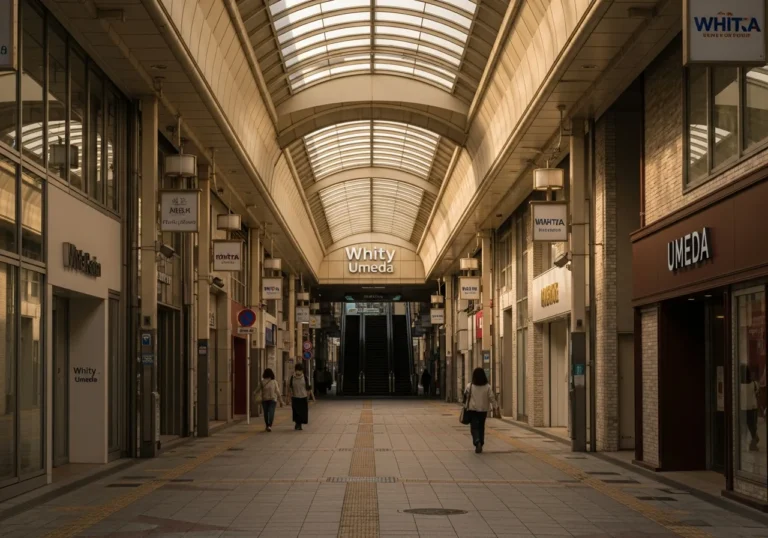
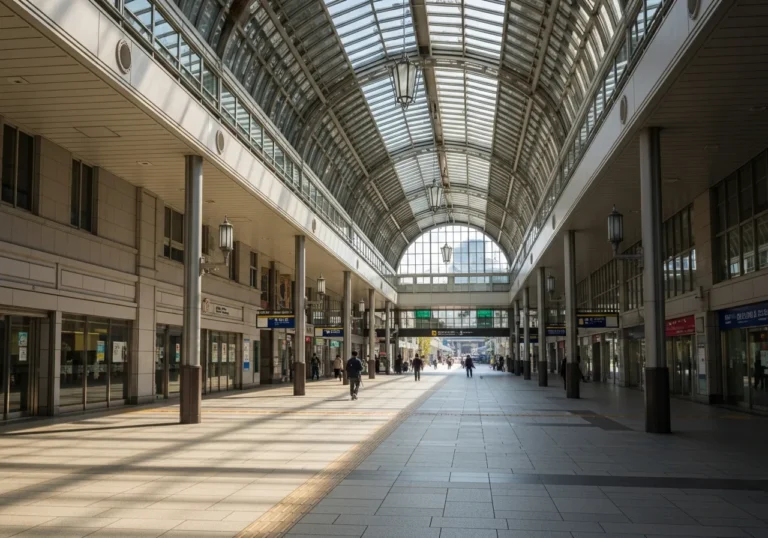
Stand at the Umeda end of Midosuji on any weekday morning and you feel the city breathing. Ten-car trains surface briefly before plunging underground again.
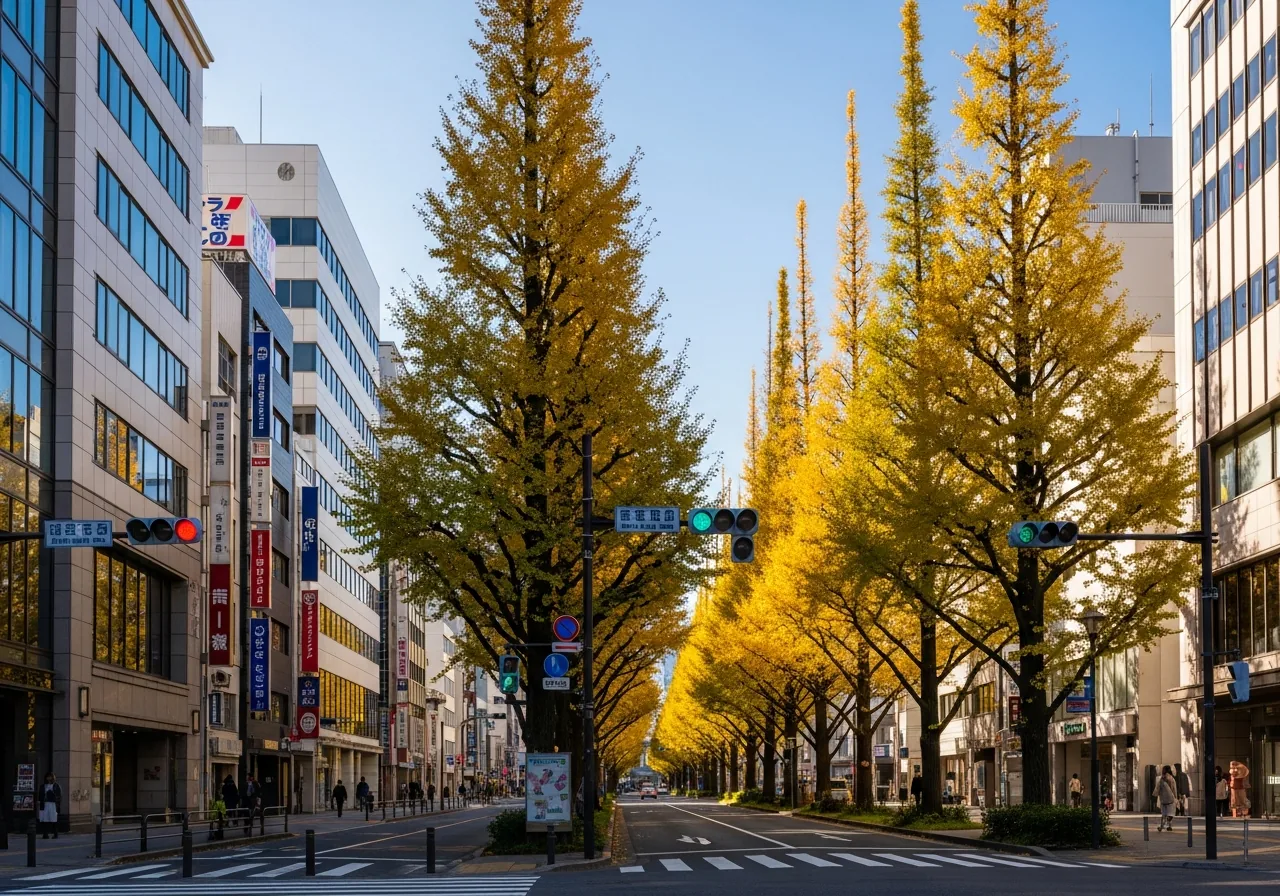
Ginkgo trees, nearly a thousand of them, line both kerbs in four parallel rows, their trunks thick enough now that two people cannot link hands around them. Louis Vuitton, Chanel, and Hermès occupy the ground floors of buildings whose facades still carry the ghost of 1930s modernism.
The whole corridor — four kilometres of it, from the department stores of Umeda to the neon of Namba — moves with a confidence that makes it hard to believe anyone ever thought it was a mistake.
But they did. Loudly, and for years.
Why Did Osaka Even Need a New Boulevard?
The Chuo Ward heritage record puts it plainly: for most of its history, the street that would become Midosuji was a narrow lane just six meters wide. In the Edo period it was called Yodoyabashisuji, and it ran through the dense merchant quarter of Semba, hemmed in on both sides by the kind of tight wooden townhouses that made Osaka simultaneously the wealthiest and most combustible city in Japan.
At the end of the sixteenth century, roughly the same time as the construction of Osaka Castle, development of the area around Midosuji began, and an urban area formed with “dori” running east to west and “suji” running north to south. At the time, the east-west dori were the main roads for traffic, and although Midosuji was a busy road, it was a very narrow one, having a width of only about six meters.
The logic of that layout was entirely pre-modern. Osaka’s wealth moved by water — along the canals that threaded the city like capillaries — and the east-west streets connected the warehouses to the rivers.
A north-south axis was commercially secondary. Goods did not need to travel from Umeda to Namba; they needed to travel from the Dojima rice market to the sea.
Even in the Meiji era (1868–1912), the dori were still the primary roads for traffic, but once Umeda and Namba stations were built, the need for a north-south axis increased. The railway had done what the canal never had: it created two poles of gravity at opposite ends of the city, and suddenly the six-meter lane between them was a bottleneck in the body of a rapidly industrializing metropolis.
By the 1920s, Osaka was not merely growing — it was exploding. As textile and other cottage industries developed, the city expanded, and its population grew to surpass Tokyo, making Osaka the largest city in Japan.
Trams clogged the surface streets. Rickshaws competed with delivery carts.
The city that called itself the “kitchen of the nation” was choking on its own success, and the narrow north-south corridor at its centre was the most obvious symptom.
Why Here, and Why So Impossibly Wide?
The answer to both questions is the same man: Hajime Seki (関一, 1873–1935), the scholar-mayor who governed Osaka from 1923 until his death in office in 1935, and who is the closest thing this city has to a founding urban planner.
Seki graduated from what is now Hitotsubashi University in 1893 and worked in the Ministry of Finance until he became a professor at his alma mater in 1897. The following year, he left for Europe, where he spent three years studying in Belgium. In 1910, he obtained the title of Doctor of Juridical Science.
Those three years in Belgium were formative in ways that would eventually reshape Osaka’s skyline. Seki arrived in Brussels at the height of the European city-beautiful movement, when Haussmann’s transformation of Paris was still fresh enough to be debated rather than merely admired. He returned to Japan with a conviction that cities were not merely economic machines but social organisms — that the shape of streets determined the shape of lives.
Professor Seki served the city of Osaka as deputy mayor from 1914 until his death in 1935. He saw cities as “social subjects,” “vital organs” of the people’s national economy, and not, as landowners and bureaucrats did, as a mere economic phenomenon.
This was a radical position in interwar Japan, where urban planning was largely understood as a tool of industrial productivity. Seki, trained as a political economist in the late 1890s when Japan was focused single-mindedly on “increasing industrial production,” distinguished himself early on as a people-centered, rather than a state-centered, national economist.
His intellectual biography, The City as Subject, written by Jeffrey E. Hanes and published by the University of California Press, remains the definitive English-language account of how Seki translated those convictions into concrete asphalt.
Midosuji was planned in the first urban planning of Osaka City in the 1920s, and specified as the first-grade road in the plan. Construction was started in 1926, and completed in 1937.
The width — 44 meters — was not chosen arbitrarily. It was chosen to accommodate a subway beneath the road surface, six lanes of motor traffic above it, wide pedestrian footpaths on both sides, and four rows of trees.
Seki was not building for 1926. He was building for a city he could see coming but that his contemporaries could not yet imagine.
In 1926, when Osaka had few north-south streets, city planners proposed creating broad boulevards, and construction to expand Midosuji began. The redesign of Osaka’s main street was inspired by Paris and other European cities.
The Paris comparison is not mere flattery. Haussmann’s boulevards had been built wide enough to prevent the barricade-building that had paralysed the city during the revolutions of 1830 and 1848 — a fact Seki would have known.
But Seki’s motivations were different. He was not trying to suppress revolution; he was trying to prevent the conditions that caused it.
He advocated that urban planning and policymaking should be aimed at increasing the living conditions of city dwellers. According to him, without a model preventing the formation of new slums, renovation and slum improvement policies were only temporary solutions.
Thus, to really improve living conditions, upgrading of existing neighborhoods was to be conducted in parallel with outskirt planning.
Why Did Osaka Mock the Plan?
Because it looked insane. A six-meter lane becoming a 44-meter boulevard: that is not widening a road, that is demolishing a neighbourhood and replacing it with a road. The scale was genuinely difficult to comprehend for people who had never seen a Haussmann boulevard or a Champs-Élysées.
The construction of the subway coincided with the widening of the road from 6 to 44 meters, making Osakans joke that an airplane could land on the newly named Midosuji Avenue. The joke was not affectionate. It was the kind of sarcasm that Osaka — a city that has always prided itself on practical commercial sense over bureaucratic grandeur — deploys when it thinks public money is being wasted.
Mayor Seki faced strong opposition from the citizens, who said, “Are you planning to build an airport?” But he still managed to realize a plan that looked to the future.
The opposition was not only aesthetic. Widening the road required the demolition of hundreds of properties in the densest commercial district in western Japan.
Semba’s merchant families had occupied those plots for generations. Their warehouses, their storefronts, their machiya townhouses — all of it had to go.
Seki’s dual engagement with Western theories and practical city reforms as vice mayor highlights the complexities and challenges faced in implementing progressive urban policies amid opposition from political elites and landowners.
And then there was the money. The Great Depression was tightening its grip on Japan by the time construction was fully underway.
Osaka’s municipal finances were under severe strain. Building a subway simultaneously with the road — the two projects were inseparable in Seki’s plan — required bond financing on a scale the city had never attempted.
In 1925, Osaka City outlined a comprehensive proposal for four subway lines spanning a total of 54.5 km, with the Midosuji Line prioritized as the primary north-south corridor to connect key commercial districts and alleviate surface-level congestion from trams and roads. Funding for the project came primarily from the Osaka municipal government through local bonds and revenues generated by the city’s existing tram network, which helped offset the substantial construction debts during the early Showa period.
Seki’s genius — or his gamble, depending on how you read history — was to frame the construction not merely as infrastructure but as employment. The construction of the Midosuji line was also seen as an opportunity to create work for Osaka’s many unemployed during the Great Depression.
In this, he was ahead of Keynesian thinking that would not reach mainstream economic policy for another decade. The boulevard and its subway were, simultaneously, a public works programme, a social reform, and a century-long urban bet.
Why Was the Subway Built Beneath the Road at All?
This is the question that unlocks the engineering logic of the whole project. Seki did not simply decide to widen a road and then notice there was room for a subway underneath. The subway was the reason the road needed to be so wide in the first place.
Building a subway under an existing city requires digging up the surface above it. The open-cut method — essentially, excavating a trench, building the tunnel box inside it, and then covering it over — was the only technique available in Japan in the late 1920s.
The Umeda-Shinsaibashi section was dug entirely by hand and plagued by the terrible composition of the earth and poor engineering skills. The combination of the two caused much water leakage and cave-ins in the northern construction site during the start of the project.
If you are going to dig up a street to build a subway, you need the street to be wide enough that you can dig one half while traffic continues on the other. A six-meter lane offered no such margin. The 44-meter boulevard was, in part, a construction management solution: the road had to be wide enough to build the thing underneath it.
The Midosuji Line was the first subway line in Osaka and the first government-operated subway line in Japan. The first cars were hauled onto the line by manpower and pack animals from the Government Railway tracks near Umeda. Although the line only operated with single cars at first, its stations were designed from the outset to handle trains of up to eight cars.
That last detail is worth pausing on. The stations were built for eight-car trains when the line opened with a single car.
The platforms were so long, and the trains so short, that passengers had to run along the platform to find the one spot where the doors would open. It was absurd in 1933.
It was prescient by 1963.
The Midosuji Line opened on May 20, 1933, initially as a 3.1-kilometer segment between a temporary Umeda Station and Shinsaibashi Station, marking the debut of underground rail service in the city. The road above it would not be complete for another four years. For that entire period, Osaka was simultaneously a construction site and a city trying to function as normal — a condition that will feel familiar to anyone who has navigated the city during the Expo 2025 preparations.
Why Did the Boulevard Survive the War?
This is not a trivial question. It is estimated that more than 10,000 civilians died in the bombing of Osaka.
Osaka was the second largest city in Japan, with a population of 3,252,340 in 1940. The air raids of 1945 destroyed vast swaths of the city.
During the early hours of March 14th 1945, Shinsaibashi and Namba districts were heavily bombed by air raids engulfing the area in raging flames.
The boulevard itself, as a physical structure, survived — not because it was protected, but because wide roads are inherently fire-resistant. The incendiary bombing campaigns that devastated Japanese cities in 1945 worked by creating firestorms: fires that jumped from building to building, fed by the dense wooden construction of traditional Japanese urbanism.
A 44-meter boulevard is a firebreak. The very width that Osaka’s citizens had mocked as absurd turned out to be a survival mechanism.
The buildings along it did not all survive. Kita-Mido, along with Minami-Mido, was beloved by the people of Osaka, but was burned down in the Great Osaka Air Raid of 1945.
Both temples — the very buildings that gave the street its name — were destroyed and had to be rebuilt in the postwar decades. But the road itself, the subway beneath it, the underground infrastructure that Seki had insisted on building to a scale that seemed preposterous in 1933 — all of it survived, and all of it was ready to carry the traffic of Japan’s postwar economic miracle.
There is a particular irony here. The subway stations had been built to handle eight-car trains at a time when single cars were running.
Seki’s vision of an integrated and extensive public transportation network finally came to fruition when Osaka drowned in traffic jams during the economic boom of the 1960s. The city launched an ambitious subway construction program and by 1969 had created numerous extensions and four completely new lines.
The Midosuji Line, with its over-engineered stations and its wide tunnels, was ready for the surge. Tokyo’s older Ginza Line, built to a more modest specification, could never expand beyond six cars.
Midosuji ran ten.
Why Did the Name Come From Two Temples?
Before it was a boulevard, before it was even a proper road, the lane that would become Midosuji was defined by two religious institutions that stood on either side of it. Kitamido Temple (Honganji sect Tsumura Betsuin) and Minamimido Temple (Otani sect of Shinshu Namba Betsuin) were established after Toyotomi Hideyoshi divided Honganji Temple into Otani (east) and Honganji (west) sects. The name “Mido-suji” comes from the fact that the road passes by the front of the two Betsuin (Mido) temples.
The word mido (御堂) means “honorable hall” — a reverent popular name for a Honganji temple. Suji simply means “street.” So Midosuji is, literally, “the street of the honorable halls.” After giving up the castle, Honganji moved to what is now Midosuji, Osaka’s central boulevard, which was even named after the temple: Mido, the Honorable Hall, was the popular name for the Honganji temple.
The deeper history here is remarkable. The Ishiyama Honganji — the fortress-temple that once stood where Osaka Castle now stands — was one of the most powerful religious institutions in medieval Japan.
These temples are all that remain of Ishiyama Honganji Temple, which played a crucial role in shaping Osaka into what it is today. Ishiyama Honganji Temple was allegedly located where Osaka Castle currently stands.
When Toyotomi Hideyoshi finally persuaded the temple to vacate that strategic site in the late sixteenth century, its successor institutions relocated to the lane that would eventually become Midosuji.
So the street’s name encodes a history of religious power, political negotiation, and urban displacement that predates the modern city by three centuries. When you walk Midosuji today, you are walking a path that was already significant before Seki was born, before Japan industrialized, before the concept of urban planning existed in the Western sense. The boulevard is modern; the axis is ancient.
Why Did the Design Include Underground Cables and a Building Height Limit?
This is where Seki’s vision becomes most legible as a coherent aesthetic and civic project, not merely an engineering one. He did not simply want a wide road. He wanted a specific kind of street — one that would look like the great European boulevards he had studied, and that would remain that way for generations.
The boulevard opened in 1937 with a vision of Osaka’s development 100 years into the future. From the start, all electric cables were underground, approximately 800 ginkgo trees were planted, and the skyline of surrounding buildings was limited to 30 metres, creating a beautiful landscape that has garnered attention. Today, the skyline has been relaxed to 50 metres, and commercial facilities and office buildings line the street.
Burying the electric cables was an extraordinary decision for 1937 Japan. Overhead wires were the visual signature of modernizing Asian cities — Tokyo was festooned with them, as were Shanghai and Seoul.
Choosing to put them underground was expensive, technically demanding, and entirely invisible to the public once done. It was the kind of decision that only a mayor who thought in decades rather than electoral cycles would make.
The ginkgo trees were chosen with equal deliberateness. Ginkgo (Icho) is one of the oldest tree species on earth — a living fossil, essentially unchanged for 200 million years.
It is also one of the few trees that survived the atomic bombing of Hiroshima, sprouting again from scorched roots. Whether Seki knew this last fact is unknowable — the Hiroshima bombing was eight years in the future when the trees were planted — but the choice of a tree associated with resilience and longevity was not accidental.
More than 800 ginkgo trees line the boulevard, each meticulously managed by the city with individual maintenance records. This beautiful scenery exists thanks to the quiet efforts of countless people behind the scenes.
The 30-metre building height limit was the most consequential design decision of all. It meant that for decades, the buildings along Midosuji could not overwhelm the trees.
The street would remain human in scale even as the city grew. In the period from 1955 to 1970, 26 buildings were built on all blocks along Midosuji in the high economic growth era.
They were planned to the full size of the then architectural restriction, growing demand for utilization of the city centre. Consequently, Midosuji possessed a townscape with a completed wall line and skyline.
The height limit held long enough to establish the character of the street before it was eventually relaxed.
The Ginkgo Trees as Civic Property
The trees deserve a paragraph of their own, because they have become something more than decoration. The ginkgo trees were designated as Osaka City’s Designated Cultural Property in 2000 and were selected as one of Yomiuri Shimbun’s Street Tree 100 New Scenery of Japan.
When Typhoon Jebi struck Osaka in 2018 and damaged many of the trees, some companies made donations to help with the recovery of these trees. One company in the city even stocked up on ginkgo trees as a backup so they can be used to quickly repair or replace damaged trees in case another devastation happens.
Private companies voluntarily stockpiling replacement trees for a public boulevard. That is the measure of how deeply Midosuji has been absorbed into Osaka’s civic identity — not as a government asset but as a shared possession, something the city’s businesses feel personally responsible for maintaining.
Why Did the Boulevard Become a Financial District?
The answer is partly Seki’s design and partly simple geography. Once the subway was running and the road was complete, Midosuji was the most accessible corridor in the city. The line transformed Osaka, feeding the city’s new business, shopping and entertainment centres in Umeda, Yodoyabashi, Honmachi, Shinsaibashi and Namba, and making it easier for Osaka’s middle class to move out of the city and into the suburbs.
Banks and trading companies understood immediately that a building on Midosuji was a statement of permanence and solidity. The wide road, the underground cables, the controlled skyline — all of it signalled that this was a street built to last, and that the city government was serious about maintaining it. Midosuji street became a business centre home to many banks and main branches of companies.
The financial district that formed along the Yodoyabashi and Honmachi sections of the boulevard in the postwar decades was not planned in the way that Seki had planned the physical infrastructure. It emerged organically from the logic of the street itself: the widest, most accessible, most prestigious address in Osaka attracted the institutions that needed to project width, accessibility, and prestige.
Then, as Japan’s economy shifted from industrial production to consumption in the 1980s and 1990s, the southern section of Midosuji — from Shinsaibashi to Namba — transformed again. The banks and trading companies remained in the north; the luxury brands moved into the south.
Today Midosuji is an ultra high-class shopping street, housing clothing stores by such brands as Louis Vuitton and Chanel, major hotels, and even an Apple flagship. The same street, the same 44 metres, the same ginkgo trees — but a completely different economic function in its southern half.
Why Does the Subway Beneath It Matter So Much?
Because it is, by any measure, one of the most important pieces of urban infrastructure in Japan. The Midosuji Line serves as the network’s busiest route, carrying approximately 900,000 passengers daily (as of 2025) and linking major transportation hubs including Shin-Osaka Station, Umeda Station, Namba Station, and Tennoji Station.
Nine hundred thousand passengers a day. On a line that opened with a single car, on a platform built for eight, dug by hand through waterlogged ground by workers who had never built a subway before.
Osaka has the most dramatic daytime/nighttime population change of any city in the country — the amount of commuters from outside is so great that the daytime population increases by about 50% on weekdays. The Midosuji Line is the mechanism by which that daily population surge is absorbed and distributed.
The stations themselves are worth examining as objects. Because they were designed from the outset for eight-car trains, they are unusually generous in scale for a 1930s subway — wide platforms, high ceilings, a sense of space that Tokyo’s older lines, built to tighter specifications, cannot match. That over-engineering, mocked in 1933 as wasteful, is now experienced daily by nearly a million people as simple comfort.
Why Should a Discerning Traveller Care?
Not because Midosuji is beautiful, though in autumn it is genuinely beautiful — from mid-November, the ginkgo leaves turn bright yellow, creating a breathtaking contrast with the modern skyscrapers and luxury shops along Osaka’s main street. Not because it is historically significant, though it is. But because it is one of the clearest examples anywhere in the world of what happens when a city makes a decision that looks wrong in the short term and right in the long term.
Most cities do not make that kind of decision. Most cities build to the scale of the present moment, and then spend the next century trying to retrofit infrastructure that was never designed for what the city became.
Osaka, in the 1920s and 1930s, had a mayor who understood that the city he was governing was not the city he was building for. He built for a city that did not yet exist, at a scale that seemed absurd, at a cost that seemed reckless, against opposition that seemed reasonable.
He was right. The citizens who asked whether he was building an airport were wrong. And the boulevard they mocked is now the reason Osaka functions as well as it does.
There is also a more personal reason to care, which is this: Midosuji is one of the few places in a major Japanese city where you can feel the full argument of urban planning made physical. Walk it from Umeda to Namba — it takes about an hour at a comfortable pace — and you are walking through a century of decisions.
The width of the road is a decision. The trees are a decision.
The buried cables are a decision. The height of the buildings is a decision.
Every element of what you see was chosen by someone who thought carefully about what a city should be, and then fought to make it happen.
That is rarer than it looks. Most cities are the accumulated result of thousands of small decisions made by people who were not thinking about the whole.
Midosuji is the result of one man’s vision, executed over eleven years of construction, completed two years after he died. It is, in the most literal sense, a monument to a particular idea about what cities are for.
Why Is Midosuji Changing Again Now?
Because the argument that Seki made in 1926 — that the city should be built for the future, not the present — is being made again, this time about cars versus people.
Osaka plans to realize the full pedestrianization of Midosuji by 2037 to celebrate the 100-year memorial of its construction. The target date is not accidental.
2037 is exactly a century after the boulevard opened. The city is explicitly framing the pedestrianization as a continuation of Seki’s project, not a departure from it.
Midosuji is the first street in Japan to be designated as a “pedestrian friendly road.” This concept, commonly known as “Hokomichi,” was established following a revision of the Road Law in 2020 by the Ministry of Land, Infrastructure, Transport and Tourism. As of March 2025, plans are underway to turn the sidewalks from Namba Station to Shinbashi intersection, where Midosuji and Nagahori-dori intersect, into pedestrian paths, creating a multi-use road known as a “hokomichi.”
The logic is the same as Seki’s, inverted. He widened the road because the city was choking on foot traffic and needed motor vehicles and a subway to move people efficiently.
Now the subway moves the people, car traffic on Midosuji is declining, and the sidewalks are overcrowded with tourists and pedestrians. Just before the plan was proposed, Midosuji’s sidewalks were becoming overcrowded due to a dramatic increase in tourists.
At the same time, car traffic was decreasing. So the idea was proposed: “Why not create a street where pedestrians could set up shop and perform, a sort of Central Park, while ensuring pedestrian safety?”
The street that was mocked for being too wide for cars is now being celebrated for being wide enough to give back to people. The airport runway is becoming a park. Seki, who spent three years studying European cities and came home convinced that streets should serve human life rather than merely facilitate movement, would have found this entirely logical.
What Remains to Be Understood
The honest answer is: quite a lot. The internal city-council debates of the late 1920s, the precise sequence of property acquisitions and demolitions, the experiences of the Semba merchant families who lost their buildings to make way for the boulevard — these are stories that exist primarily in Japanese-language archives and have not been fully translated into the English-language record. Jeffrey Hanes’s biography of Seki is the most thorough English account of the political and intellectual context, but it is a biography of a man, not a history of a street, and the street’s construction history deserves its own scholarly treatment.
What we do know is the outcome. Seki’s vision of an integrated and extensive public transportation network finally came to fruition when Osaka drowned in traffic jams during the economic boom of the 1960s.
The city that mocked him built its entire postwar identity on the infrastructure he left behind. The subway he insisted on building for eight-car trains now carries nine hundred thousand people a day.
The road he insisted on building at 44 metres is about to become a pedestrian boulevard.
Every city has streets. Very few cities have streets that embody an argument. Midosuji is one of them — and the argument it embodies, about the relationship between present cost and future benefit, about the obligation of a city government to think beyond the electoral cycle, about the difference between building for now and building for a century hence, is as live today as it was when Osaka’s citizens were asking whether their mayor had lost his mind.
He had not. He was simply looking further ahead than they were.
Frequently Asked Questions
Q: How long is Midosuji, and how long does it take to walk?
A: Midosuji stretches approximately 4 km from Umeda to Namba. Walking the full length at a comfortable pace, with stops to look at the architecture and the sculptures, takes about 60 to 75 minutes. The subway beneath it covers the same distance in under ten minutes.
Q: When is the best time to visit for the ginkgo trees?
A: The Midosuji ginkgo leaves usually reach their peak colour from mid-November to early December. Late November is considered the best time, when the leaves are most vibrant and the entire boulevard glows in golden hues. Arrive early morning for photography; the crowds build significantly by mid-morning.
Q: Is Midosuji a one-way street?
A: Midosuji is a one-way street going south, so if you start in Umeda and walk toward Namba, the traffic flow makes the route intuitive. The pedestrianization plans currently underway will eventually change this, but as of August 2026 the road remains one-way for vehicles.
Q: What are the sculptures along the boulevard?
A: In 1991, Osaka City established the Mido-suji Urban Sculpture Installation Committee and began collecting donations from businesses located on and near Mido-suji. Starting with the installation of the first of these sculptures, “Eve” by Auguste Rodin, works by leading artists from Japan and around the world decorate Mido-suji. There are now 29 sculptures in total, placed at intervals along the footpaths.
Q: What is the Hokomichi project, and when will it be complete?
A: Hokomichi is a Japanese government designation for pedestrian-priority roads that can be used by cafes, food trucks, and street performers. Osaka plans to realize the full pedestrianization of Midosuji by 2037 to celebrate the 100-year memorial of its construction. Sections near Namba are already being converted on a trial basis as of 2025.
Midosuji Boulevard — Visitor Information
Address: Midosuji, Chuo-ku / Kita-ku, Osaka 530-0001 / 大阪府大阪市中央区・北区 御堂筋(梅田〜難波、約4km)
Nearest station: Osaka-Umeda Station (Midosuji Line) for the north end; Namba Station (Midosuji Line) for the south end. Multiple stations along the route: Yodoyabashi (3 min walk), Hommachi (1 min walk), Shinsaibashi (1 min walk).
Hours: Open at all times (public road). Ginkgo illumination events run November–December evenings; confirm exact dates on the official site each year.
Admission: Free (public boulevard). Individual venues along the street vary.
Official site: city.osaka.lg.jp